
.svg "kloia.png")
By Halit Altuner on Jun 5, 2026, 8:50:07 AM

Introduction
Every IoT project starts the same way: one device sends data, something receives it, and something else processes it. Simple enough.
But when the number of devices grows from tens to thousands or even millions, one architectural decision starts to matter more than almost anything else: which MQTT broker are you running?
A broker is not just a message pipe. It is the nervous system of your IoT architecture. It determines how your devices authenticate, how your data flows, how your system scales under load, and how much control you retain over your infrastructure.
Today, two names dominate this conversation: HiveMQ and AWS IoT Core. Both are production-grade, battle-tested, and capable of handling serious IoT workloads. However, they represent fundamentally different philosophies regarding where intelligence should live, who controls the infrastructure, and how tightly your IoT stack should be coupled to a cloud provider.
This article is a structured comparison between the two, not to declare a winner, but to provide the framework you need to make the right decision for your own architecture.
MQTT 101: A Quick Refresher
MQTT (Message Queuing Telemetry Transport) is a lightweight publish/subscribe messaging protocol designed for constrained environments: low bandwidth, high latency, unreliable networks, and resource-limited devices.
Originally developed by IBM in the late 1990s to monitor oil pipelines over satellite connections, MQTT has become the backbone of modern IoT communication.
In MQTT, producers and consumers are decoupled through a broker. A temperature sensor does not know who is listening to its data, it simply publishes to a topic. Anyone subscribed to that topic receives the message. The broker handles the routing.
QoS Levels
|
QoS |
Name |
Guarantee |
Typical Use Case |
|
0 |
At most once |
Fire-and-forget |
Telemetry where occasional loss is acceptable |
|
1 |
At least once |
Guaranteed delivery, duplicates possible |
Commands, alerts |
|
2 |
Exactly once |
Guaranteed delivery without duplicates |
Financial transactions, critical control systems |
HiveMQ: The Enterprise MQTT Broker
HiveMQ is a purpose-built MQTT broker developed by HiveMQ GmbH specifically for enterprise-grade IoT deployments. It follows an MQTT-first philosophy, every architectural decision is centered around doing MQTT exceptionally well.
HiveMQ runs everywhere: on-premise (bare metal or VM), Kubernetes (official Helm chart and Operator), cloud marketplaces (AWS, Azure, GCP), edge environments (HiveMQ Edge), and as a fully managed service (HiveMQ Cloud). This deployment flexibility is critical for industries with strict data residency requirements.
One of HiveMQ’s most distinctive capabilities is its extension framework. Every aspect of broker behavior, including authentication, authorization, message transformation, persistence, and observability, can be customized through Java-based extensions without modifying the broker itself.
HiveMQ’s customer base paints a clear picture: BMW, Audi, Siemens, Bosch. Industries where data sovereignty, regulatory compliance, and infrastructure control are non-negotiable.
Strengths
- Full support for MQTT 3.1, 3.1.1, and 5.0
- Extension framework for deep customization
- Strong Kubernetes-native deployment model
- Data residency and compliance friendly
- HiveMQ Edge for gateway-level intelligence
- Built-in Prometheus integration
Limitations
- Requires infrastructure management expertise
- Licensing costs for enterprise features
- Cloud service integrations often require custom work
- Smaller managed ecosystem compared to AWS IoT Core
AWS IoT Core: The Cloud-Native MQTT Broker
AWS IoT Core is Amazon’s fully managed MQTT broker service, although calling it “just a broker” understates what it really is. It is a gateway into the broader AWS IoT ecosystem: device management, rules engine, device shadow service, fleet indexing, and over-the-air updates.
The biggest difference compared to HiveMQ is operational responsibility: there is no broker to deploy, no cluster to manage, and no capacity planning to perform. AWS IoT Core automatically scales to billions of messages and millions of simultaneous connections.
AWS IoT Core’s Rules Engine allows you to define SQL-like queries on incoming MQTT messages and route them into more than 20 AWS services without writing custom code.
The Device Shadow service maintains a persistent JSON document representing the desired and reported state of each device, even when the device is offline.
Strengths
- Zero infrastructure management
- Automatic scaling to billions of messages
- Deep native integration with the AWS ecosystem
- Powerful Rules Engine for serverless message routing
- Device Shadow for offline state management
- Built-in fleet management and OTA updates
- Pay-per-message pricing model
Limitations
- Vendor lock-in, tightly coupled to AWS
- Data residency limited to AWS regions
- More limited customization compared to HiveMQ extensions
- Partial MQTT 5.0 support
- Costs can increase significantly at very high scale
- Less suitable for air-gapped deployments
Architectural Comparison
At the most fundamental level, the difference is the deployment model.
HiveMQ gives you a broker that you own and operate.
AWS IoT Core gives you a broker that you consume as a service.
This trade-off between ownership and simplicity drives nearly every other distinction between the two platforms.
|
Category |
HiveMQ |
AWS IoT Core |
|
Deployment |
Self-managed (Kubernetes, VM, bare metal) |
Fully managed SaaS |
|
MQTT 5.0 |
Full support |
Partial support |
|
Edge support |
Native (HiveMQ Edge) |
Via AWS Greengrass |
|
Offline operation |
Yes |
Limited |
|
Custom authentication |
Extension framework |
Lambda authorizer |
|
Data residency |
Full control |
AWS regions only |
|
Rules / routing |
Custom consumers |
Built-in Rules Engine |
|
Cloud integration |
Requires custom work |
Native AWS integration |
|
Scalability |
Manual cluster management |
Automatic |
|
Observability |
Native Prometheus |
CloudWatch |
|
Vendor lock-in |
None |
High |
|
Operational complexity |
High |
Low |
|
Cost model |
License + infrastructure |
Pay as you go |
|
Best suited for |
Enterprise, industrial IoT |
Cloud-native SaaS |
Hybrid Architecture: The Best of Both Worlds
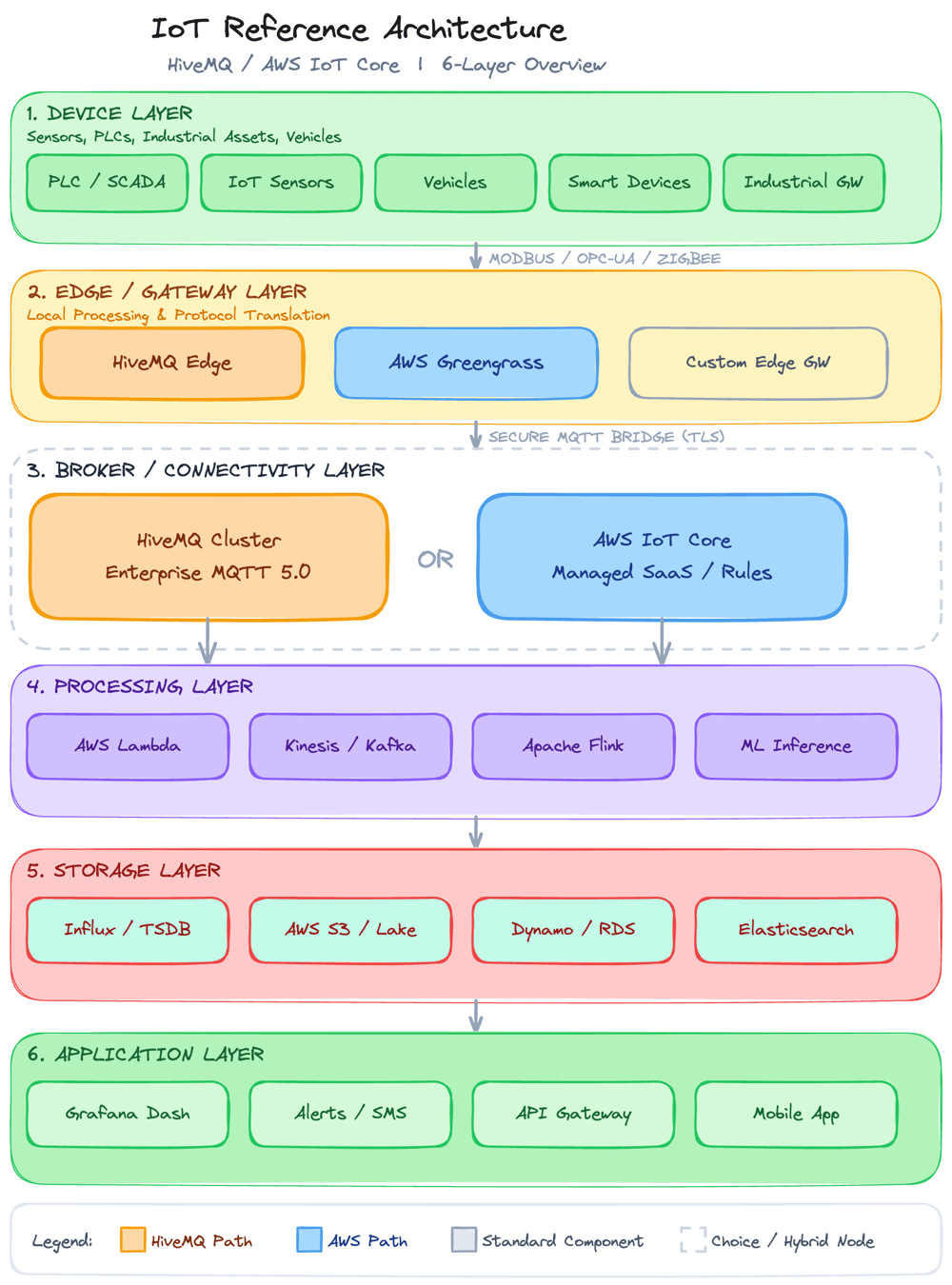
Architecturally, the most mature answer is often using both platforms together where each one is strongest.
HiveMQ Edge handles local device connectivity, data filtering, and protocol translation. Only relevant and pre-processed data is forwarded into AWS IoT Core through an MQTT bridge.
AWS IoT Core then handles cloud-scale analytics, storage, and integrations.
The system continues operating even if cloud connectivity is interrupted.
Industry Use Cases
|
Industry |
Primary Choice |
Secondary Role |
|
Automotive |
HiveMQ |
AWS IoT Core (analytics) |
|
Industrial IoT / SCADA |
HiveMQ Edge |
AWS IoT Core (cloud analytics) |
|
Smart Buildings |
AWS IoT Core or HiveMQ |
Depends on data residency requirements |
|
Fintech IoT |
HiveMQ |
AWS IoT Core (monitoring) |
|
Consumer IoT |
AWS IoT Core |
HiveMQ (regulated environments) |
|
SaaS Platforms |
AWS IoT Core |
HiveMQ (enterprise customers) |
|
Connected Vehicle Telemetry |
HiveMQ |
AWS IoT Core (data lake) |
Decision Framework
Before committing to either platform, answer these five questions honestly:
1. Where does your data need to live?
If your architecture requires strict geographic or organizational data residency, AWS IoT Core becomes immediately constrained. HiveMQ becomes your starting point.
2. How reliable is your network connectivity?
If your devices operate in intermittently connected environments, you need a broker capable of offline operation. HiveMQ Edge was designed for exactly this purpose. AWS IoT Core was not.
3. How much infrastructure can your team realistically operate?
HiveMQ requires real operational expertise. If your team lacks this capability, the simplicity of AWS IoT Core is not merely convenience — it is a strategic advantage.
4. How tightly are you willing to couple yourself to AWS?
AWS IoT Core is a gateway into the AWS ecosystem. If you ever need to migrate away or support multi-cloud deployments, that dependency can become a liability.
5. What is your message volume and cost sensitivity?
At very high scale, economics often begin to favor self-hosted HiveMQ deployments. Run the numbers for your own workload before making the decision.
Summary
|
If you are… |
Choose… |
|
A startup building a consumer IoT product |
AWS IoT Core |
|
An enterprise with regulated data |
HiveMQ |
|
Operating industrial / SCADA systems |
HiveMQ Edge |
|
A SaaS platform serving enterprise customers |
Both |
|
Building connected vehicle infrastructure |
HiveMQ + AWS IoT Core (analytics) |
|
A small team without infrastructure expertise |
AWS IoT Core |
|
Running extremely high message volumes |
HiveMQ (evaluate costs carefully) |
|
Requiring multi-cloud or cloud-agnostic architecture |
HiveMQ |
Conclusion
There is no universally correct MQTT broker.
HiveMQ and AWS IoT Core are both excellent platforms, they are simply excellent for different things, different organizations, and different operational contexts.
HiveMQ is the right answer when control, compliance, and edge intelligence matter more than operational simplicity.
AWS IoT Core is the right answer when speed, simplicity, and cloud-native integration matter more than infrastructure ownership.
The most sophisticated architectures use both: HiveMQ at the edge and in regulated environments, AWS IoT Core in the cloud for analytics and scale.
The real question is not which broker is better.
The real question is: what does your architecture actually need?
At Kloia, we help engineering teams design IoT architectures that balance control, scalability, and operational complexity. If you are evaluating this decision, we would be happy to talk.
Resources
HiveMQ
AWS IoT Core
MQTT and IoT
Kloia Blog
.png?width=1920&height=1072&name=running-dpdk-on-kubernetes-with-sriov-multus-cni%20(1).png)
Running DPDK on Kubernetes with SR-IOV & Multus CNI

What is new in DotNET 5.0
No Comments Yet
Let us know what you think