
.svg "kloia.png")
By Hriday Prabhakar on Oct 7, 2026, 8:36:42 AM
The model can work perfectly in a demo and still be the smallest part of the production problem. The real challenge is turning a useful experiment into a service that can be secured, evaluated, observed, funded and owned over time.
AI proofs of concept are easier to build than they have ever been. A small team can connect a foundation model to a few documents, add a lightweight interface and demonstrate a useful workflow in days or weeks. That speed is valuable because it lets teams answer an important first question quickly: is there enough value here to keep investing?
The difficulty begins when the answer is yes. Production replaces sample data with live data, temporary credentials with managed identity, mocked integrations with real systems, and informal testing with measurable quality thresholds. The application now needs incident ownership, cost controls, auditability and a release process that can roll back a bad change. The model may behave exactly as it did in the POC; the surrounding system has changed completely.
RAND's 2024 report is often cited in this discussion because it notes that, by some external estimates, more than 80% of AI projects fail. The scope matters: that figure is not a failure rate measured by RAND's interview sample. RAND's own practitioner interviews instead found recurring causes such as leadership misunderstanding the problem, poor or unsuitable data, and insufficient investment in infrastructure. Deloitte found a similar scaling gap from another angle: nearly 70% of surveyed organizations said only a small portion of their generative AI experiments had moved into full production. The useful conclusion is not that AI itself is failing; it is that experimentation and production are different engineering problems.
Platform engineering matters because it can make the second problem repeatable. It cannot turn a weak use case into a good one, and it cannot clean bad data by itself. What it can do is provide a supported path for model access, identity, deployment, observability, evaluation, governance and cost management so that every successful POC does not have to invent those foundations from scratch.
At a glance
| >80% | Nearly 70% | +8% / +10% / +6% |
| AI projects fail by some estimates cited by RAND; the report itself focuses on root causes rather than measuring that rate. | Organizations said only a small portion of GenAI experiments had moved into full production. | Individual productivity / team performance / organizational performance associated with using an internal developer platform. |
| RAND Corporation, 2024 | Deloitte, 2024 | DORA, 2024 |
What's Inside?
- What a POC proves — and what it does not
- An illustrative enterprise RAG scenario
- Where platform engineering changes the production path
- How the same path can be implemented on AWS
- The production concerns that deserve explicit engineering
- Six questions to answer before launch
- What platform engineering cannot solve
The POC is not the production system
A POC is a learning instrument. It should remove unnecessary complexity so the team can test the value of the idea without paying the full production cost up front. If the goal is to learn whether an internal assistant can answer questions from company documents, the team does not need a complete production identity model, 24/7 alerting and disaster recovery before it tests retrieval quality and user usefulness.
That shortcut is sensible, but it hides work. A prototype might use a developer credential, a hand-picked dataset and one happy-path integration. Production has to cope with changing data, real permissions, dependency failures, provider quotas, model or prompt changes and users who will not behave like the demo script. The common mistake is not building the POC quickly; it is interpreting a successful demo as evidence that the production system is almost finished.
What changes when the demo becomes a service?
|
Area |
During the POC |
In production |
|
Data |
Selected samples or snapshots |
Live, changing data with quality, lineage and permission constraints |
|
Identity |
Developer or temporary credentials |
Service identities, end-user authentication, least privilege and auditable access |
|
Integrations |
Mocks or narrow test connections |
Real CRM / ERP / APIs with latency, limits, retries and partial failures |
|
Quality |
Manual review of a small set of examples |
Repeatable evaluation sets, release thresholds and regression detection |
|
Observability |
Application logs are often enough |
Traces across prompts, retrieval, models, tools, latency, errors and cost |
|
Ownership |
The builder is nearby |
On-call, escalation, rollback, security response and long-term service ownership |
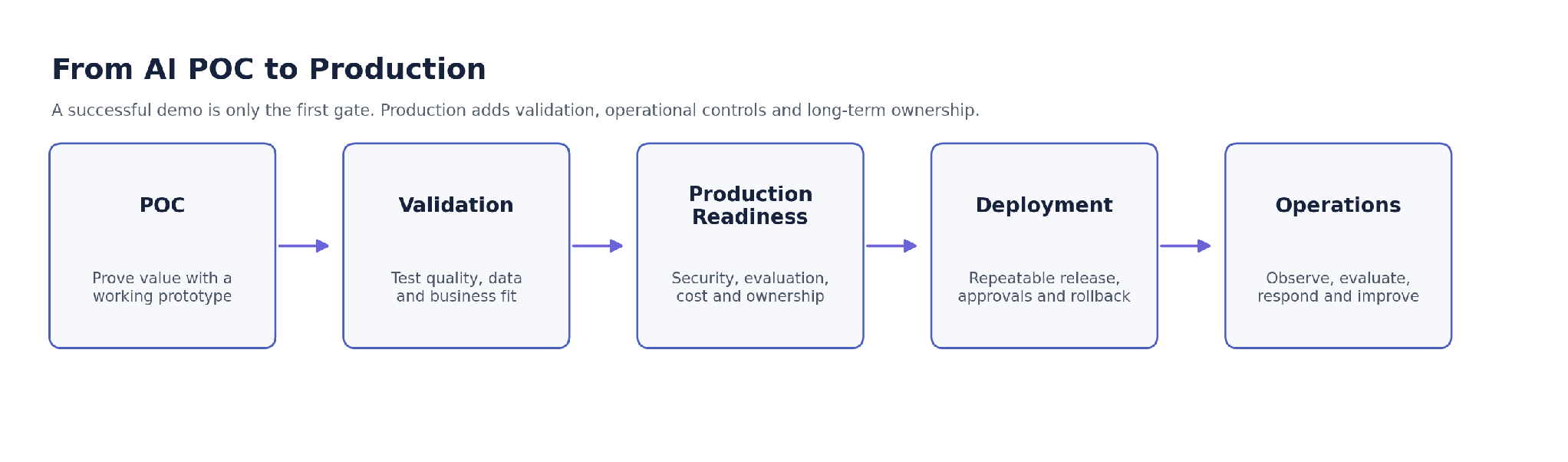
Figure 1. From AI POC to production: the prototype is one stage in a longer delivery and operating lifecycle.
|
The hidden shift. A POC asks, “Can this work?” Production has to answer, “Can we operate this safely, repeatedly, measurably and at a cost that still makes sense?” |
Illustrative scenario: when an internal AI assistant moves to production
|
Illustrative example — not a customer case study. The numbers below are deliberately simple to show how requirements change between a POC and production; they are not measured Kloia project results. |
Consider an internal RAG assistant built against 100 carefully selected documents. A handful of employees test it, the answers are useful, and the team can easily inspect the source documents when something looks wrong. At that scale, a lightweight retrieval pipeline and manual review may be enough to demonstrate value.
Now assume the same assistant is approved for production and has to work across more than 50,000 documents from multiple teams. Employees have different permissions. Content changes every day. Some documents are duplicated, some are stale, and some contain information that should never be returned to certain users. Usage grows from a few test questions to thousands of daily queries. Prompt, model and retrieval changes now need to be released without quietly making the system worse.
The requirements change in five important ways
- The corpus becomes an operating system, not a folder. Ingestion, indexing, freshness, metadata and deletion all need to be managed continuously.
- Permissions move into the retrieval path. The system must return relevant information without exposing documents the requesting user is not allowed to see.
- Quality needs a repeatable test. The team needs known questions and expected results so retrieval and generation changes can be compared before release.
- Economics become visible. Embedding, retrieval, model inference, retries, tracing and storage all contribute to the cost per successful business task.
- Change management becomes part of AI quality. A new model or prompt can improve one class of question while degrading another, even if the deployment itself is technically healthy.
This is where the production platform changes the shape of the work. The product team should still own the assistant's behavior, user experience and domain-specific quality bar. The platform can provide the identity patterns, supported data connectors, evaluation hooks, deployment pipeline, telemetry and cost attribution that let those product decisions be implemented consistently.
Platform engineering is the bridge — not the destination
Kloia describes a Golden Path as the supported, opinionated route from “I need a service” to “it is running”: conventions made executable and maintained as a product. That idea fits AI particularly well because the model call is only one component of a production system. The useful platform is the one that standardizes the repeated operational work around that call without taking product decisions away from the team that understands the use case.
DORA's platform engineering research supports the value of that approach, while also adding an important warning. In its 2024 report, people using an internal developer platform were 8% more productive, teams performed 10% better and organizational performance increased by 6%. DORA also found that poorly implemented platforms can reduce change stability and throughput. Its current guidance emphasizes developer independence, clear feedback and a minimum viable platform rather than a centralized “golden cage.”
What the platform should standardize and what it should leave to the product team
|
Platform responsibility |
Product / AI team responsibility |
|
Approved model access, identity, secrets and network policy |
Choosing the use case, user experience and business behavior |
|
Repeatable deployment, promotion, rollback and environment conventions |
Prompting, retrieval strategy and domain-specific logic |
|
Default logging, tracing, evaluation hooks and cost attribution |
Defining the quality threshold and deciding which failures matter |
|
Reusable connectors, guardrails and audit integration |
Deciding where human judgment or approval is required |
|
Operational conventions and incident integration |
Owning the measurable outcome that justifies keeping the system in production |
|
Start smaller than “build an AI platform.” A strong first step is a minimum viable production path for the repeated 80%: model access, identity, deployment, telemetry, evaluation and cost visibility. Expand it when real teams repeatedly hit the same next problem. |
From AI POC to production on AWS
On AWS, the platform-engineering idea maps naturally to managed services, but the goal is not to collect as many AWS products as possible. The useful question is which production requirement each service is helping the team satisfy. The exact architecture will vary by workload, data source and regulatory boundary; the table below is a practical starting point rather than a mandatory blueprint.
|
Production requirement |
AWS example |
Why it matters |
|
Model access |
Amazon Bedrock |
Managed access to foundation models without the application owning model infrastructure. |
|
Identity & access |
AWS IAM; Amazon Cognito or IAM Identity Center where appropriate |
Separate workload permissions from end-user identity and apply least privilege. |
|
Secrets |
AWS Secrets Manager |
Keep API keys and credentials out of source code and developer machines; rotate and audit access. |
|
Enterprise RAG |
Amazon Bedrock Knowledge Bases + enterprise data sources |
Managed retrieval over enterprise data, with connectors and document-level permission filtering where supported. |
|
Evaluation |
Amazon Bedrock Evaluations |
Measure retrieval and generation quality with metrics such as context relevance, correctness, faithfulness and citation quality. |
|
Deployment |
Amazon ECS / Amazon EKS / AWS Lambda, depending on runtime |
Give the application a repeatable release path that matches its runtime and scaling needs. |
|
Observability |
Amazon CloudWatch generative AI observability |
Trace prompts, models, knowledge bases and tools while monitoring latency, token use, errors and cost attribution. |
|
Audit |
AWS CloudTrail |
Record API activity and support investigation, governance and compliance workflows. |
|
Cost visibility |
AWS Cost Explorer + AWS Budgets + tagging / allocation |
Track spend by workload or team and set thresholds before an inefficient workflow scales. |
|
Important permission nuance. Amazon Bedrock Managed Knowledge Base can perform ACL-aware retrieval for supported data sources, but AWS explicitly notes that ACL awareness is not authentication or a complete authorization boundary. The application still has to authenticate the user and pass trusted identity context into retrieval. |
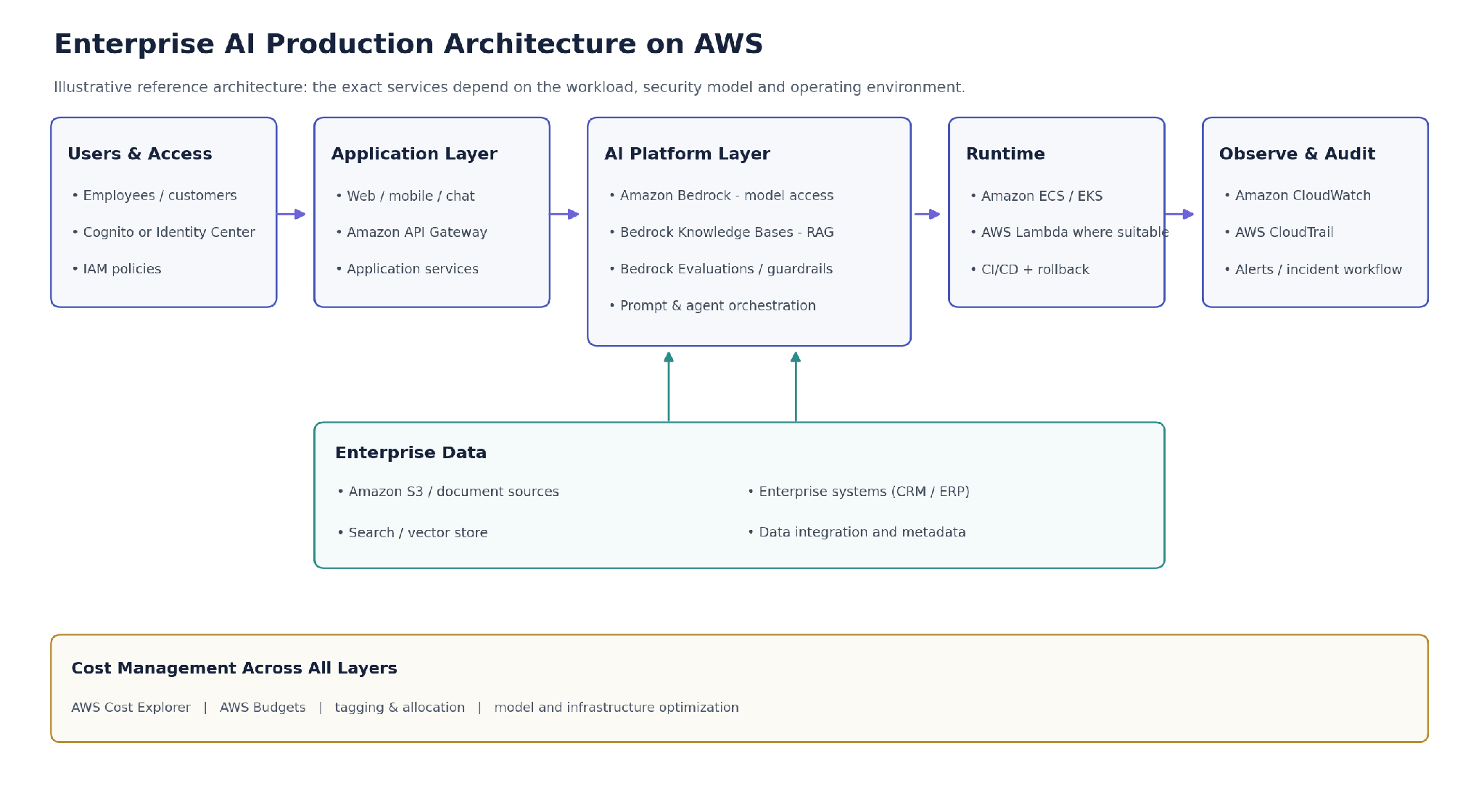
Figure 2. Illustrative enterprise AI production architecture on AWS. The services shown are examples, not a one-size-fits-all reference stack.
Where production gets hard
1. Data and permission boundaries
AI systems are unusually dependent on the quality and permissions of the context they receive. A strong model cannot compensate for stale product data, a missing document, inconsistent metadata or a retrieval pipeline that returns content the user should not see. RAND's interviews identified limitations in data quality and utility as one of the most frequent causes of AI project failure, and Deloitte reported that 75% of surveyed organizations had invested in data lifecycle management to support their GenAI strategies.
For RAG in particular, production readiness means treating ingestion and permissions as ongoing services rather than setup tasks. The platform can make connectors, metadata conventions and identity propagation reusable, but the owning team still has to decide which sources are authoritative and how quickly changes must become searchable.
2. Observability has to include AI quality
A production AI service can be technically available and still be failing its users. It can return HTTP 200 responses while retrieval quality falls, token usage doubles, a tool call starts timing out or a prompt change makes answers less useful. Traditional service metrics remain necessary, but they are not sufficient.
Modern observability therefore needs enough context to reconstruct an interaction: model and prompt version, retrieved sources, latency, token usage, tool calls, errors and, where appropriate, evaluation results. AWS has moved in this direction with CloudWatch generative AI observability, which includes model-invocation metrics and end-to-end prompt tracing for components such as knowledge bases, tools and models.
During an incident, can the team answer these questions?
- Which version ran? Application release, model, prompt and retrieval configuration.
- What context did it see? User input, system instructions and retrieved documents.
- What did it do? Tool calls, API responses, authorization decisions, retries and fallbacks.
- Was the output actually good? Task-level quality or evaluation signals, not only infrastructure health.
- What did the task cost? Tokens, retrieval, tools, retries and downstream infrastructure for that successful or failed outcome.
3. Security changes when the system can act
The risk profile changes again when an AI system moves from generating text to taking actions. A summarization assistant has a limited blast radius; an agent that can modify a customer record, open a support case, run infrastructure automation or trigger a business process needs explicit boundaries around what it can access and what it is allowed to change.
Those boundaries are easier to manage when identity, approval points, audit trails and kill switches are built into the runtime path rather than added separately by every project. This is also where the platform should resist over-automation: a high-risk action may still need a human checkpoint even if the model is capable of executing it autonomously.
4. Economics and ownership arrive together
The useful unit of AI cost in production is rarely 'price per model call.' A business task may include retrieval, embeddings, several model calls, tool execution, retries, observability and evaluation. A cheaper model can be more expensive overall if it causes more retries or human escalations, while a more capable model can justify its higher inference price if it reduces the number of steps needed to finish the task.
Cost therefore needs to be visible alongside quality and operational ownership. Deloitte found that more than 40% of organizations struggled to define and measure the impact of their GenAI initiatives. A system that is technically healthy but has no agreed measure of value, no cost envelope and no team responsible for incidents is not ready simply because the demo worked.
AI Production Readiness: 6 Questions to Answer Before Launch
This is the practical checkpoint worth agreeing on before a POC is treated as a production candidate. The exact thresholds will differ by use case, but the categories should not be a surprise after the demo.
|
Question |
Evidence to have before launch |
|
1. What business outcome justifies production? |
A measurable target such as time saved, conversion, support deflection, task accuracy, revenue impact or another outcome the business agrees matters. |
|
2. How will quality be measured? |
A repeatable evaluation set, an agreed release threshold and a way to detect regressions after prompt, model or retrieval changes. |
|
3. What data and tools can the workload access? |
Known data sources, user and workload identity, least-privilege permissions, secrets management, auditability and approval boundaries for actions. |
|
4. What happens when dependencies fail? |
Timeouts, retries, fallbacks, model/provider failure behavior, rollback and a clear degraded mode rather than an undefined outage. |
|
5. What is the cost per successful business task? |
Projected usage, cost attribution, budgets or alerts, and enough telemetry to see which model, tool or retry is driving spend. |
|
6. Who owns the service after launch? |
Named operational ownership, alerts, incident response, escalation, security response, rollback authority and a plan for ongoing evaluation and improvement. |
|
A simple rule. If the answer to one of these questions is “we will figure that out after launch,” the system may be a promising POC, but it is not yet a production service. |
What platform engineering cannot solve
A production path is valuable only if the underlying idea deserves to continue. RAND's practitioner interviews are useful here because the most frequently cited causes of failure were not infrastructure problems: leadership choosing or framing the wrong business problem and limitations in the data were more prominent. Platform engineering can surface those constraints earlier, but it cannot make an unwanted product useful or turn unsuitable data into evidence.
That means a healthy AI program should not aim for a 100% POC-to-production conversion rate. Some experiments should stop. The platform's job is to make the decision better: expose realistic integration effort, evaluation results, security constraints and cost while the project is still cheap to change.
A POC should earn the right to continue
|
Signals to continue |
Signals to stop or rethink |
|
Users repeatedly complete the target task faster or better |
The demo is impressive but the workflow does not improve a meaningful outcome |
|
Evaluation results are stable enough to define a threshold |
Quality depends on hand-picked examples or repeated manual rescue |
|
Real data access and integrations are feasible and supportable |
The use case depends on data or permissions the organization cannot reliably provide |
|
Projected cost per successful task makes sense at real volume |
The economics only work at demo-scale usage |
|
A team is willing to own the service after launch |
Nobody wants operational responsibility once the POC team moves on |
Final thoughts: make the road reusable, not the demo bigger
The POC-to-production problem is easy to misdiagnose because the model is the most visible part of the system. When a demo succeeds, the natural response is to improve the prompt, add more data or choose a better model. Those changes may improve the product, but they do not create identity, deployment, audit, observability, evaluation, cost ownership or an incident process. Production is not simply a larger POC; it is a different operating contract.
Platform engineering helps when it turns that contract into a supported path. A team that proves value should already know how its workload will authenticate, where secrets live, how changes are promoted, what telemetry is collected, how quality is evaluated and who receives an alert when something breaks. The platform does not need to own the AI product. It needs to make the repeated operational constraints predictable enough that the product team can focus on the part that is genuinely unique.
The best outcome is not that every experiment ships. Good POCs should move faster because the road is already there, and weak POCs should stop sooner because real cost, data, quality and governance constraints become visible before months of hardening work are invested. That is a healthier measure of AI maturity than the number of demos an organization can produce.
For the next AI POC, the useful question is therefore not only “Can we build this?” It is also “If it works, do we know what production means?” Organizations that can answer both questions will be in a much better position to turn AI experimentation into reliable business capability.
Ready to Move Your AI POC into Production?
|
Building a successful AI prototype is only the beginning. Scaling it requires the right architecture, security, evaluation, observability and operational foundations. As an AWS Premier Tier Services Partner with a GenAI Competency, Kloia focuses on the engineering required to move from proof of concept to resilient production environments on AWS. Let's turn your AI POC into a production-ready solution. Contact our GenAI team → |
References and supporting reading
2. Deloitte — The State of Generative AI in the Enterprise
3. DORA — 2024 Accelerate State of DevOps Report
4. DORA — Platform engineering capability guidance
5. Kloia — Building a Golden Path: Kubernetes Self-Service with Backstage, Part 2
6. Kloia — Generative AI Services
7. Kloia — AI-Driven Delivery Lifecycle (AI-DLC)
8. AWS — Amazon Bedrock Knowledge Bases
9. AWS — Amazon Bedrock Evaluations
10. AWS — RAG evaluation metrics in Amazon Bedrock
11. AWS — ACL-aware retrieval in Bedrock Managed Knowledge Base
12. AWS — CloudWatch generative AI observability
13. AWS — Identity and Access Management (IAM)
15. AWS — CloudTrail
Manage Kubernetes Secrets with External Secrets Operator and AWS SSM

Amazon Bedrock Claude ValidationException: cause and solution
.png?width=1920&height=1080&name=kubernetes-standardization-helm-argocd-gitops%20(1).png)
No Comments Yet
Let us know what you think