
.svg "kloia.png")
The Problem
No company context
AI tools write code without knowing your codebase, your specs, your stored procedures, your standards. Generic in, generic out.
Zero audit trail
Nobody knows what changed, by whom, against which spec, at what cost. When something breaks, the log is empty.
Knowledge stays siloed
The senior engineer's head is still the source of truth. The pipeline learns nothing. That person leaves, the knowledge walks out.
Pilot never becomes default
The shiny demo works. Then adoption stalls. The new way of working never replaces the old one.
Why AIDLC?
Faster delivery
Tens of dollars per feature, hours of elapsed time. Not weeks.
Built-in compliance
Every action audited. Every dollar attributed to an issue.
Institutional memory
The pipeline learns. The org's knowledge stops walking out the door.
Faster onboarding
New engineers ramp on a pipeline that already knows the codebase.
A pipeline that improves
Each cycle's retro feeds the next cycle's configuration.
Humans stay in control
Agents propose. Humans approve. Every merge is gated.
Problems
No company context
Zero audit trail
Knowledge stays siloed
Pilot never becomes default
Why AIDLC?
Faster delivery
Built-in compliance
Institutional memory
Faster onboarding
A pipeline that improves
Humans stay in control
OpenTelemetry:
Baked in, not bolted on
Auto-instrumentation of .NET and Java services → ADOT collector sidecars on EKS → AWS X-Ray for distributed tracing → CloudWatch for metrics and logs → custom dashboards and SLO alerting. All traces, metrics, and logs flow through a single OTel pipeline, swap backends without re-instrumenting.
VM → Container replatforming
Move off bare VMs onto EKS with proper orchestration, autoscaling, and workload isolation.
Custom metrics
Business and technical KPIs exported via OTel metrics SDK to CloudWatch and Managed Prometheus.
Structured logging
JSON-structured logs with trace correlation IDs, shipped to CloudWatch Logs Insights.
SLO alerting
Composite alarms and SLO burn-rate alerts wired from day one not as an afterthought.
What changes in your architecture
AWS Landing Zone & multi-account governance
AWS Control Tower
Security baseline
Identity & access
Network architecture
FinOps & cost governance
Compliance as code
Measurable results our clients achieve
60-80%
infrastructure cost reduction vs on-prem VMs
10x
faster deployments via GitOps pipelines
99.9%+
availability through EKS self-healing & multi-AZ
<5 min
MTTR with full OTel trace-to-log correlation
Case Study - Akbank
Multi-account governance on AWS with Control Tower
100%
Account setup automated
0
Manual account setup
Client: Akbank
Project type: Migration to AWS
Website: www.akbank.com
Situation
Client context and the opportunity.
Akbank is a major player in the finance industry with a strong focus on innovation. To evaluate new technologies internally, Akbank decided to onboard AWS and build a controlled environment for these workloads.
In this process, Akbank wanted to strengthen the working areas of its IT teams. It started the AWS Migration Acceleration Program (MAP) in partnership with Kloia. AWS MAP provides the development, application, and test environments customers need on AWS. The main aim is maximum efficiency during the transition.
Task
What needed to be done and the constraints.
The core challenge was the difficulty of managing multiple accounts and the security gaps that had to be closed as the environment scaled. Three requirements defined the scope:
- Manage multiple AWS accounts without heavy operational overhead.
- Close security gaps across all accounts.
- Provide centralized log management and automate the setup of environments and accounts using AWS services.
A key constraint: separate environments were needed for both applications and users. Creating and configuring a new account manually for each user was not viable.
Action
Technologies, decisions, and steps taken, and why.
Kloia deployed AWS Control Tower as the foundation. Control Tower provides the fastest way to set up and govern a secure, multi-account AWS environment, called a landing zone. It builds the landing zone using AWS Organizations, which gave Akbank a single place to manage environments and teams.
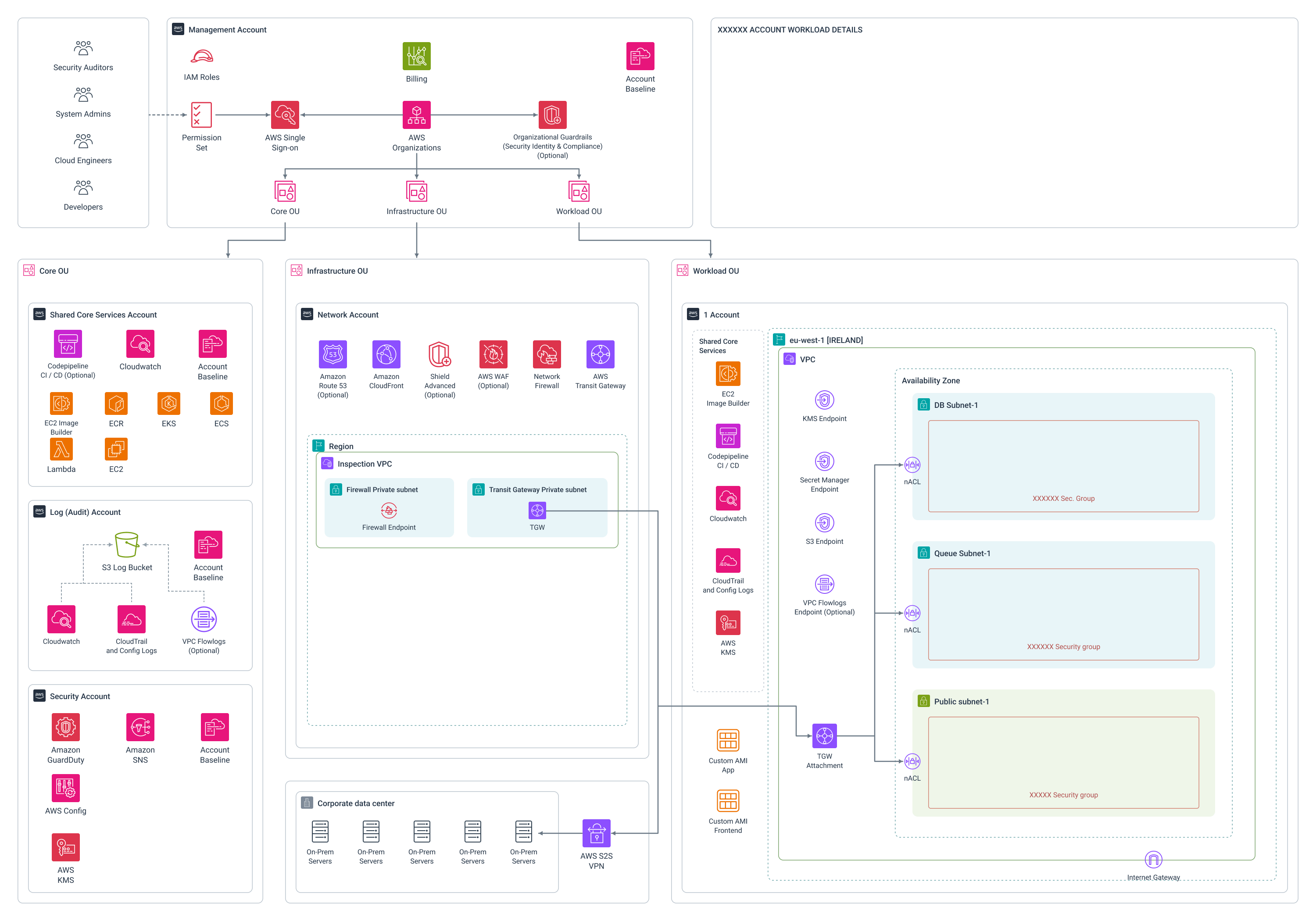
Account setup and access
- Provisioning: New AWS accounts were provisioned quickly through Control Tower, replacing manual per-user configuration.
- Governance: Authorizations were enforced through AWS Organizations with SCP (Service Control Policies).
- Access control: Service and account access was restricted using SSO through Control Tower.
Cost optimization
- Automation: Unused resources were creating unnecessary cost. Lambda functions were used to track specific CloudWatch parameters and stop these resources as needed.
Centralized log management and security
- Security: A common Security Account was used to check probes across the organization. AWS GuardDuty and AWS Config were enabled here, creating a security layer for auditing and threat detection.
- Log management: A dedicated Log Management Account was created under a Core Organizational Unit. Logs from user and account owner transactions were managed from a single place using AWS CloudTrail.
Results
Outcomes achieved and business impact.
Akbank moved from fragmented account handling to a governed, automated multi-account setup on AWS:
- Multi-account management established and governed through Control Tower.
- Automated setup of all Organization account configurations, removing manual per-account effort.
- Central security and logging mechanisms in place with GuardDuty, AWS Config, and CloudTrail.
- Cost optimization for unused resources through automated Lambda based controls.
Case Studies

Open-Source Observability Transformation on AWS
Open-Source Observability Transformation on AWS