
.svg "kloia.png")
The Problem
No company context
AI tools write code without knowing your codebase, your specs, your stored procedures, your standards. Generic in, generic out.
Zero audit trail
Nobody knows what changed, by whom, against which spec, at what cost. When something breaks, the log is empty.
Knowledge stays siloed
The senior engineer's head is still the source of truth. The pipeline learns nothing. That person leaves, the knowledge walks out.
Pilot never becomes default
The shiny demo works. Then adoption stalls. The new way of working never replaces the old one.
Why AIDLC?
Faster delivery
Tens of dollars per feature, hours of elapsed time. Not weeks.
Built-in compliance
Every action audited. Every dollar attributed to an issue.
Institutional memory
The pipeline learns. The org's knowledge stops walking out the door.
Faster onboarding
New engineers ramp on a pipeline that already knows the codebase.
A pipeline that improves
Each cycle's retro feeds the next cycle's configuration.
Humans stay in control
Agents propose. Humans approve. Every merge is gated.
Problems
No company context
Zero audit trail
Knowledge stays siloed
Pilot never becomes default
Why AIDLC?
Faster delivery
Built-in compliance
Institutional memory
Faster onboarding
A pipeline that improves
Humans stay in control
OpenTelemetry:
Baked in, not bolted on
Auto-instrumentation of .NET and Java services → ADOT collector sidecars on EKS → AWS X-Ray for distributed tracing → CloudWatch for metrics and logs → custom dashboards and SLO alerting. All traces, metrics, and logs flow through a single OTel pipeline, swap backends without re-instrumenting.
VM → Container replatforming
Move off bare VMs onto EKS with proper orchestration, autoscaling, and workload isolation.
Custom metrics
Business and technical KPIs exported via OTel metrics SDK to CloudWatch and Managed Prometheus.
Structured logging
JSON-structured logs with trace correlation IDs, shipped to CloudWatch Logs Insights.
SLO alerting
Composite alarms and SLO burn-rate alerts wired from day one not as an afterthought.
What changes in your architecture
AWS Landing Zone & multi-account governance
AWS Control Tower
Security baseline
Identity & access
Network architecture
FinOps & cost governance
Compliance as code
Measurable results our clients achieve
60-80%
infrastructure cost reduction vs on-prem VMs
10x
faster deployments via GitOps pipelines
99.9%+
availability through EKS self-healing & multi-AZ
<5 min
MTTR with full OTel trace-to-log correlation
Case Study
Automating Letter of Credit Compliance with Multi-Agent AI on AWS Using Anthropic Models
5 days → <1
Target examination cycle
26
Document types automated
330
Regulatory clauses indexed & cited
7
Specialized AI agents
Situation
A fintech client is building AI-driven Letter of Credit (L/C) compliance tooling for trade finance banks. Under the manual process, L/C documents arrived by courier, were scanned, and were checked by hand against UCP 600 and ISBP 821, the international rulebooks for trade finance. A single mismatched date, amount, or party name could block a payment. The review took about five days end-to-end, and peak weeks ran at ten times normal volume.
The client asked Kloia to build the AI engine that could take on this work: read the documents, apply the rules, and produce a decision an operator could trust and act on.
Task
Kloia needed to build the AI engine behind this process: read the documents, apply the rules, and return a decision an operator could act on. The requirements set a high bar.
- Handle Messy Real-World Documents
Scanned bills of lading, faxes, born-digital PDFs, and stamped originals, arriving in one combined packet. - Check Every Field Against The Rulebook
Cross-reference each detail with UCP 600 and ISBP 821 clauses, not a hard-coded rule list. - Show Its Work
Cite the specific regulation and document evidence behind every decision, so operators can trust and audit the result. - Speak The Operator's Language
Produce a multilingual compliance report automatically. - Never leave a decision undefined
A non-answer is worse than a wrong one, because the operator is left with nothing to act on. The output had to be safe to put behind a real payment release decision.
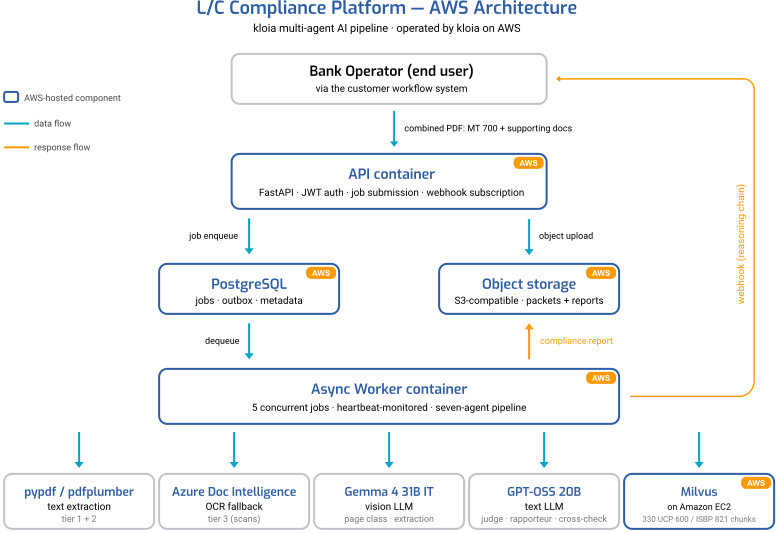
How it works: documents flow through an AWS-hosted pipeline of specialized AI agents powered by Anthropic's Claude models on Amazon Bedrock, each one checked against a live regulatory index
Action
- Multi-Agent Pipeline, Not One Big Prompt
Specialized agents (classifier, extractors, judge, rapporteur) each own one job, so the reasoning chain stays traceable end to end instead of hiding inside a single opaque call. Each agent runs on an Anthropic Claude model matched to its job, lighter models for classification, stronger reasoning models for the judge. - Retrieval-Grounded, Not a Black Box
Every verdict is backed by a live regulatory index, so answers cite the source clause and can be checked, not just trusted. - Always-On Containers, Not Serverless
The multi-agent workload keeps the Anthropic models and a live cache in memory, so a persistent compute tier beats cold-start functions on both cost and speed. - Tiered Document Reading
Fast native PDF parsing handles most pages, with OCR reserved for scans and faxes that actually need it, keeping the pipeline accurate and cost-efficient at once.
Security & Integration
- API-Based Integration
JWT-authenticated upload and job submission, with results delivered back via webhook, so the platform drops into an existing operations workflow instead of replacing it. - Isolated Per Client
Each client's worker fleet and regulatory index run independently, keeping data and processing separated between tenants. - Full Audit Trail
Every decision, document, and citation is logged, supporting internal compliance review and regulator scrutiny of AI-assisted decisioning. - No Infrastructure Burden
Kloia operates the AWS environment under the client's direction, so the client's team doesn't need to staff or maintain the AI infrastructure itself.
Built To Be Trusted With a Payment Decision
The hardest part wasn't teaching the AI to read documents. It was making sure it never left a decision undefined. Early on, the system occasionally finished its review without producing a clear answer, which is worse than a wrong one: the operator is left with nothing to act on.
Kloia built a layered safety net around the Anthropic models so the platform always produces a traceable verdict, with every fallback path logged for audit. That reliability engineering is what makes it safe to put behind a real payment release decision, not just a demo.
Results
The platform replaced manual examination end to end:
- Target examination cycle down from five days to under one.
- 26 document types automated: bills of lading, commercial invoices, certificates of origin, insurance policies, air waybills, and more.
- 330 regulatory clauses from UCP 600 and ISBP 821 indexed and cited.
- 7 specialized agents handle classification, extraction, verification, cross-checking, and reporting, work that was previously done entirely by hand.
- Accuracy is protected on every change by a golden-snapshot regression suite seeded with real client transactions. Measured outcomes against the client's target cycle time and accuracy goals are tracked by their operations team during pilot.
What This Unlocks
- Ready for multi-tenant rollout: onboarding a second bank means deploying another worker fleet against the same regulatory index, not rebuilding the platform.
- Extends to adjacent trade finance instruments (standby L/Cs, documentary collections, guarantees) by adding extractors and regulatory chunks, not rewriting the pipeline.
- Built for regulatory scrutiny: every decision carries a citation and document evidence, giving the client a defensible audit trail that a black-box model can't.
Case Studies

Open-Source Observability Transformation on AWS
Open-Source Observability Transformation on AWS