

The Problem
No company context
AI tools write code without knowing your codebase, your specs, your stored procedures, your standards. Generic in, generic out.
Zero audit trail
Nobody knows what changed, by whom, against which spec, at what cost. When something breaks, the log is empty.
Knowledge stays siloed
The senior engineer's head is still the source of truth. The pipeline learns nothing. That person leaves, the knowledge walks out.
Pilot never becomes default
The shiny demo works. Then adoption stalls. The new way of working never replaces the old one.
Why AIDLC?
Faster delivery
Tens of dollars per feature, hours of elapsed time. Not weeks.
Built-in compliance
Every action audited. Every dollar attributed to an issue.
Institutional memory
The pipeline learns. The org's knowledge stops walking out the door.
Faster onboarding
New engineers ramp on a pipeline that already knows the codebase.
A pipeline that improves
Each cycle's retro feeds the next cycle's configuration.
Humans stay in control
Agents propose. Humans approve. Every merge is gated.
Problems
No company context
Zero audit trail
Knowledge stays siloed
Pilot never becomes default
Why AIDLC?
Faster delivery
Built-in compliance
Institutional memory
Faster onboarding
A pipeline that improves
Humans stay in control
OpenTelemetry:
Baked in, not bolted on
Auto-instrumentation of .NET and Java services → ADOT collector sidecars on EKS → AWS X-Ray for distributed tracing → CloudWatch for metrics and logs → custom dashboards and SLO alerting. All traces, metrics, and logs flow through a single OTel pipeline, swap backends without re-instrumenting.
VM → Container replatforming
Move off bare VMs onto EKS with proper orchestration, autoscaling, and workload isolation.
Custom metrics
Business and technical KPIs exported via OTel metrics SDK to CloudWatch and Managed Prometheus.
Structured logging
JSON-structured logs with trace correlation IDs, shipped to CloudWatch Logs Insights.
SLO alerting
Composite alarms and SLO burn-rate alerts wired from day one not as an afterthought.
What changes in your architecture
AWS Landing Zone & multi-account governance
AWS Control Tower
Security baseline
Identity & access
Network architecture
FinOps & cost governance
Compliance as code
Measurable results our clients achieve
60-80%
infrastructure cost reduction vs on-prem VMs
10x
faster deployments via GitOps pipelines
99.9%+
availability through EKS self-healing & multi-AZ
<5 min
MTTR with full OTel trace-to-log correlation
Case Study - NeoPay
Merchant Portal on AWS
~20
Working days to deliver infrastructure
3 to 5
minutes (~240x to 400x faster) to report archive extraction (32,000+ files)
92%
CIS AWS Foundations Benchmark (May 2026 / +43 points)
Situation
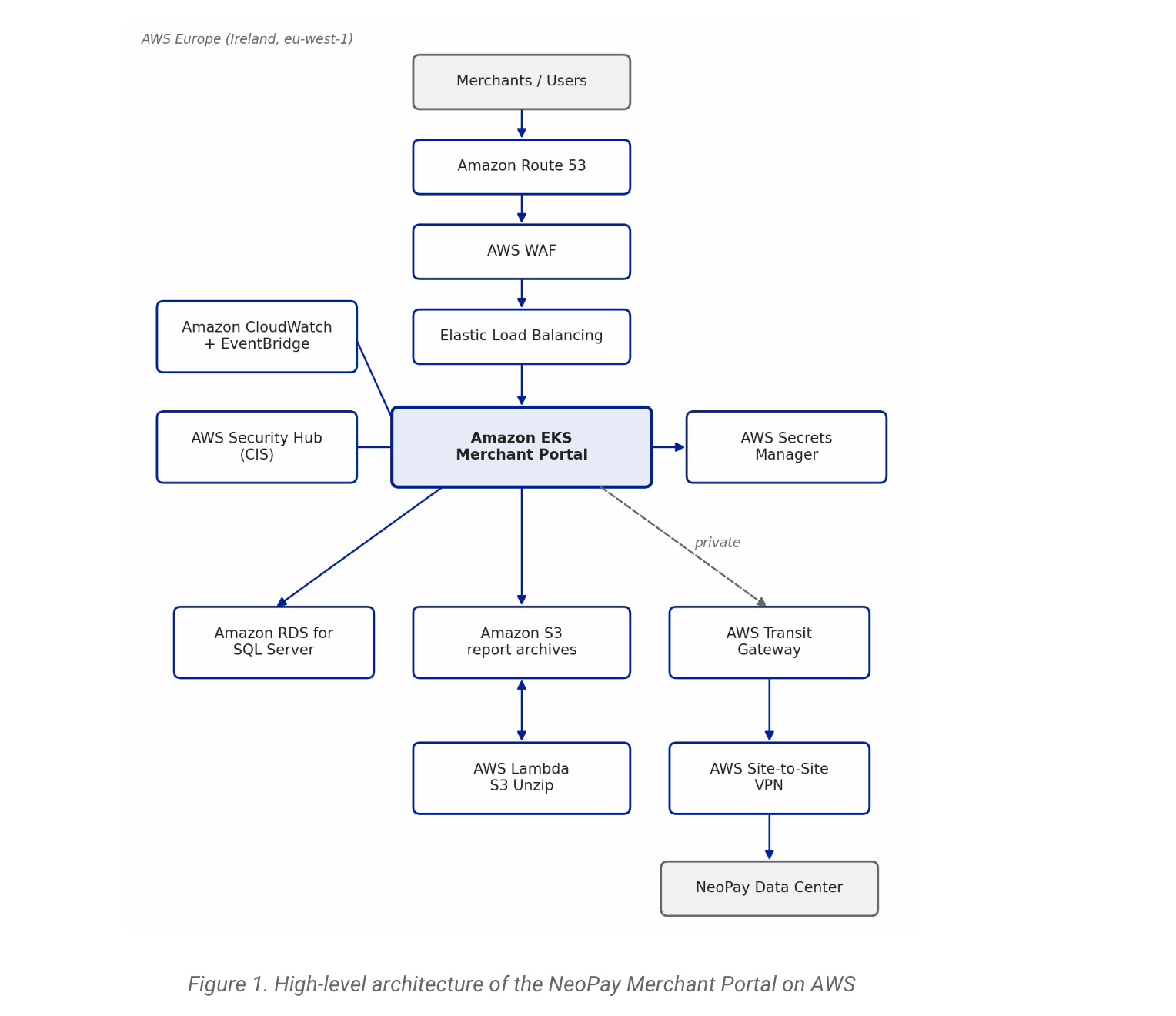
NeoPay (IDFAA Payment Services L.L.C) is a UAE-based digital payments company. Its Merchant Portal is a multi-tier merchant-facing web application, with web, application, database, and backend layers plus insight-generation services. Before this engagement the portal had never run in production. Development and trials had lived on on-premises infrastructure. AWS was going to be its first production home.
The application code belongs to a third-party vendor. It was already container-ready for Kubernetes, and had to stay that way. No rewrite was on the table.
NeoPay evaluated Microsoft Azure and Oracle Cloud Infrastructure alongside AWS, then picked AWS on three counts: migration credits, a close working relationship with the AWS account team, and kloia's depth across cloud, DevOps, and architecture beyond a pure platform build.
Task
Stand up a PCI DSS-aligned production platform on AWS, on a compressed timeline, without the vendor rewriting anything. Kick-off was 30 January 2026. Core components were targeted for 16 February 2026.
The constraints that made it real work:
- PCI DSS encryption and network segmentation across every environment.
- Private connectivity back to NeoPay's on-premises data center.
- All internet-facing traffic through AWS WAF.
- 10,000 concurrent users at peak, so managed autoscaling from day one.
- 253 million historical transaction rows to move before go-live.
- A 32,000+ file daily report archive whose extraction already took 20 hours and was blocking downstream reporting.
Definition of success: three environments (Test/UAT, Pre-Prod, Prod), PCI DSS-aligned Amazon EKS, ready for a controlled go-live in NeoPay's first production quarter on AWS.
Action
Kloia built dedicated AWS accounts per environment, all three from the same infrastructure-as-code so their shape is identical. NeoPay's earlier workloads had used two environments. We added Pre-Production because loading 253 million rows into a production-like staging ground mattered more than keeping the incumbent pattern.
The platform:
- Amazon EKS (eu-west-1) for the vendor's containers, with Linkerd for service-to-service mTLS.
- Amazon RDS for Microsoft SQL Server in private subnets, VPC-only access.
- Amazon S3 for report archives, with an AWS Lambda-driven unzip workflow replacing the 20-hour batch job.
- AWS WAF + Route 53 + ACM as the controlled public entry point, opened only inside a go-live window.
- AWS Secrets Manager for application secrets.
- Amazon ECR + ArgoCD for GitOps, fitting the vendor's existing release flow: images pushed by Git actions, pulled by ArgoCD.
- AWS Transit Gateway + Site-to-Site VPN for private connectivity to the NeoPay data center.
- CloudWatch alarms, EventBridge rules, Synthetics canaries for observability.
- AWS Security Hub tracking the CIS AWS Foundations Benchmark across the estate.
Mid-project, the AWS Middle East (UAE) region hit a service disruption. The platform had to move. Because every account, VPC, cluster, database, and rule set was in code, kloia and NeoPay redeployed into AWS Europe (Ireland, eu-west-1) and adopted it as the primary region. Not a rebuild. A redeployment.
Results
|
Metric |
Before |
After |
|---|---|---|
|
Time to deliver infrastructure |
19 to 20 day estimate |
~20 working days, on schedule |
|
Report archive extraction (32,000+ files) |
~20 hours |
3 to 5 minutes (~240x to 400x faster) |
|
CIS AWS Foundations Benchmark |
49% |
92% (May 2026), +43 points |
|
Environments with production parity |
2 |
3, built from common IaC |
|
Historical data staged for go-live |
n/a |
253 million transaction rows ETL'd into Pre-Prod |
|
UAE to Ireland region move |
n/a |
~52 additional engineering hours |
|
Customer-facing outages, Q3 2026 |
n/a |
0 |
Read together: the platform arrived on schedule, security posture climbed sharply in the months after build, the most operationally painful batch job stopped being a batch job, and the first production quarter on AWS ran without a customer-visible outage.
What this unlocks
- Merchant-insight features can adopt Amazon Bedrock inside the same governed AWS accounts.
- Future database changes and portal releases get validated in Pre-Production before they reach merchants.
- The IaC pattern that made the Ireland redeployment survivable is reusable for NeoPay's next AWS workloads: template instantiation, not a fresh design.
Lessons we'd repeat
- IaC is non-negotiable from day one, even under time pressure. The Ireland move took 52 extra engineering hours because there was nothing to click through. Hand-building first and codifying later is the trap.
- Add Pre-Production even when the incumbent workflow has two environments. 253 million rows landed somewhere safe before merchants touched the platform.
- Agree pipeline ownership with the application vendor at kick-off. Images to ECR, ArgoCD pulling them, release ownership stays clean.
Case Studies

Open-Source Observability Transformation on AWS
Open-Source Observability Transformation on AWS