

The Problem
No company context
AI tools write code without knowing your codebase, your specs, your stored procedures, your standards. Generic in, generic out.
Zero audit trail
Nobody knows what changed, by whom, against which spec, at what cost. When something breaks, the log is empty.
Knowledge stays siloed
The senior engineer's head is still the source of truth. The pipeline learns nothing. That person leaves, the knowledge walks out.
Pilot never becomes default
The shiny demo works. Then adoption stalls. The new way of working never replaces the old one.
Why AIDLC?
Faster delivery
Tens of dollars per feature, hours of elapsed time. Not weeks.
Built-in compliance
Every action audited. Every dollar attributed to an issue.
Institutional memory
The pipeline learns. The org's knowledge stops walking out the door.
Faster onboarding
New engineers ramp on a pipeline that already knows the codebase.
A pipeline that improves
Each cycle's retro feeds the next cycle's configuration.
Humans stay in control
Agents propose. Humans approve. Every merge is gated.
Problems
No company context
Zero audit trail
Knowledge stays siloed
Pilot never becomes default
Why AIDLC?
Faster delivery
Built-in compliance
Institutional memory
Faster onboarding
A pipeline that improves
Humans stay in control
OpenTelemetry:
Baked in, not bolted on
Auto-instrumentation of .NET and Java services → ADOT collector sidecars on EKS → AWS X-Ray for distributed tracing → CloudWatch for metrics and logs → custom dashboards and SLO alerting. All traces, metrics, and logs flow through a single OTel pipeline, swap backends without re-instrumenting.
VM → Container replatforming
Move off bare VMs onto EKS with proper orchestration, autoscaling, and workload isolation.
Custom metrics
Business and technical KPIs exported via OTel metrics SDK to CloudWatch and Managed Prometheus.
Structured logging
JSON-structured logs with trace correlation IDs, shipped to CloudWatch Logs Insights.
SLO alerting
Composite alarms and SLO burn-rate alerts wired from day one not as an afterthought.
What changes in your architecture
AWS Landing Zone & multi-account governance
AWS Control Tower
Security baseline
Identity & access
Network architecture
FinOps & cost governance
Compliance as code
Measurable results our clients achieve
60-80%
infrastructure cost reduction vs on-prem VMs
10x
faster deployments via GitOps pipelines
99.9%+
availability through EKS self-healing & multi-AZ
<5 min
MTTR with full OTel trace-to-log correlation
Case Study
Intelliflo Saves 65% on Infrastructure with NET Modernization on AWS
65%
lower infrastructure costs
40%
higher performance
50%
faster delivery velocity
1
future-proof architecture
About Lumo
Intelliflo, a leading financial technology company, equips over 30,000 financial advisors worldwide with innovative solutions to streamline their work and elevate client experiences. The Intelliflo platform simplifies the digital landscape, enabling advisors to deliver exceptional financial advice with ease.
Since March 2021, Intelliflo has focused on transforming the advisory process through flexible, cutting-edge technology that supports every stage of financial planning.
Problem
1. Legacy Application Limitations
Intelliflo’s 19-year-old monolithic application built on .NET Framework 4.7.2 had become increasingly difficult to maintain, scale, and evolve — both technically and organizationally. This legacy architecture slowed down innovation, made refactoring costly, and limited the company’s ability to adopt new technologies.
2. Escalating Infrastructure Costs
Running over 60 Windows Server 2022 EC2 instances on AWS EKS resulted in high compute and licensing expenses. As the customer base expanded, infrastructure costs rose disproportionately, creating inefficiency and budget pressure.
3. Talent Acquisition and Retention Challenges
Recruiting engineers interested in maintaining outdated .NET Framework code was a growing challenge. The aging stack reduced developer motivation and created long-term sustainability risks.
4. Scalability and Performance Constraints
With 600+ controllers in a tightly coupled monolithic ASP.NET MVC structure, scaling the platform required spinning up more Windows servers — an expensive and inefficient approach.
5. Integration Friction with Modern Cloud Services
Connecting the legacy application with modern APIs, CI/CD tools, and AWS-native services demanded complex workarounds, delaying feature releases and limiting innovation velocity.
Solution
Incremental Modernization Without Disruption
Rather than a risky “big bang” rewrite, Kloia implemented a phased modernization strategy ensuring zero downtime and continuous delivery throughout the transformation.
Phase 1: Assessment & Planning
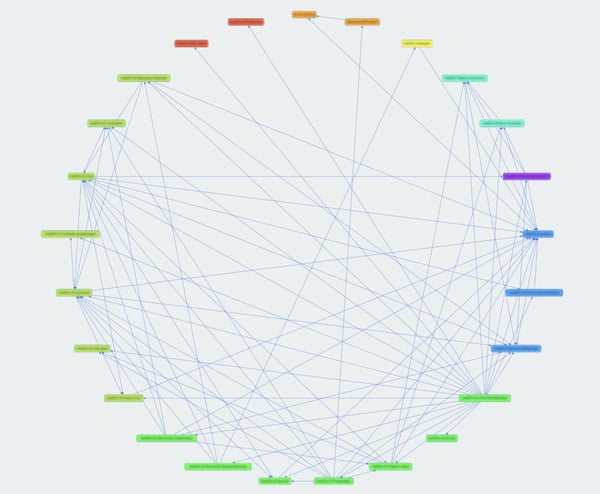
Using AWS Transform, AWS Porting Assistant for .NET, and NDepend, Kloia performed a full assessment of Intelliflo’s codebase, identifying:
-
20+ NuGet packages ready for migration
-
25+ incompatible dependencies requiring refactoring or alternatives
-
Complex interdependencies across 23 assemblies
-
A critical path centered on the WebClient module (600+ controllers)
Phase 2: Incremental Migration via .NET Standard
The migration leveraged .NET Standard 2.0 as a compatibility bridge — allowing code to work across both .NET Framework and .NET 8.
This approach enabled:
-
Continuous deployment during transformation
-
Progressive validation and risk mitigation
-
Maintained developer productivity

Phase 3: Eight-Milestone Execution Plan
-
Isolate ASP.NET Framework dependencies
-
Convert internal NuGet libraries to .NET Standard
-
Replace incompatible external libraries (e.g., DDay.iCal → Ical.Net)
-
Gradually convert solution layers to .NET Standard
-
Transform the 600+ controller WebClient to ASP.NET Core
-
Migrate and adapt test projects for .NET 8
-
Set up Linux-based CI/CD pipelines via GitHub Actions
-
Validate and cut over to production
Technical Highlights
-
Migrated Global.asax → ASP.NET Core Startup
-
Replaced web.config → appsettings.json
-
Migrated OWIN authentication → ASP.NET Core Identity
-
Refactored HttpContext → IHttpContextAccessor
-
Replaced ChartFX → Chart.js, UltimateSaml → modern SAML providers, and Enyim.Caching → IMemoryCache/IDistributedCache
-
Refactored Quartz Windows Services → containerized job schedulers
Results
Intelliflo’s modernization journey with Kloia was more than a technical upgrade — it was a strategic transformation. By leveraging AWS Transform and modern .NET practices, Intelliflo achieved measurable outcomes:
-
65% lower infrastructure costs
-
40% higher performance
-
50% faster delivery velocity
-
A sustainable, future-proof architecture
This case demonstrates that with the right strategy, partner, and execution, .NET modernization delivers tangible business value not just technical improvements.
Case Studies

Open-Source Observability Transformation on AWS
Open-Source Observability Transformation on AWS