
The Problem
No company context
AI tools write code without knowing your codebase, your specs, your stored procedures, your standards. Generic in, generic out.
Zero audit trail
Nobody knows what changed, by whom, against which spec, at what cost. When something breaks, the log is empty.
Knowledge stays siloed
The senior engineer's head is still the source of truth. The pipeline learns nothing. That person leaves, the knowledge walks out.
Pilot never becomes default
The shiny demo works. Then adoption stalls. The new way of working never replaces the old one.
Why AIDLC?
Faster delivery
Tens of dollars per feature, hours of elapsed time. Not weeks.
Built-in compliance
Every action audited. Every dollar attributed to an issue.
Institutional memory
The pipeline learns. The org's knowledge stops walking out the door.
Faster onboarding
New engineers ramp on a pipeline that already knows the codebase.
A pipeline that improves
Each cycle's retro feeds the next cycle's configuration.
Humans stay in control
Agents propose. Humans approve. Every merge is gated.
Problems
No company context
Zero audit trail
Knowledge stays siloed
Pilot never becomes default
Why AIDLC?
Faster delivery
Built-in compliance
Institutional memory
Faster onboarding
A pipeline that improves
Humans stay in control
OpenTelemetry:
Baked in, not bolted on
Auto-instrumentation of .NET and Java services → ADOT collector sidecars on EKS → AWS X-Ray for distributed tracing → CloudWatch for metrics and logs → custom dashboards and SLO alerting. All traces, metrics, and logs flow through a single OTel pipeline, swap backends without re-instrumenting.
VM → Container replatforming
Move off bare VMs onto EKS with proper orchestration, autoscaling, and workload isolation.
Custom metrics
Business and technical KPIs exported via OTel metrics SDK to CloudWatch and Managed Prometheus.
Structured logging
JSON-structured logs with trace correlation IDs, shipped to CloudWatch Logs Insights.
SLO alerting
Composite alarms and SLO burn-rate alerts wired from day one not as an afterthought.
What changes in your architecture
AWS Landing Zone & multi-account governance
AWS Control Tower
Security baseline
Identity & access
Network architecture
FinOps & cost governance
Compliance as code
Measurable results our clients achieve
60-80%
infrastructure cost reduction vs on-prem VMs
10x
faster deployments via GitOps pipelines
99.9%+
availability through EKS self-healing & multi-AZ
<5 min
MTTR with full OTel trace-to-log correlation
Case Study - Trumore
Bringing Agentic Incident Investigation to a 24-Account Amazon EKS Estate with AWS DevOps Agent
78%
Mean time to resolve production incidents down, from 100 to 22 minutes
Key AWS Services
AWS DevOps Agent, Amazon EKS, AWS Control Tower AFT, AWS Secrets Manager, AWS Transit Gateway, AWS CloudTrail
Client: Trumore, part of the Togg group
Challenge: No end-to-end view of production incidents across 24 Amazon EKS accounts and three telemetry tools
Solution: Read-only AWS DevOps Agent hub-and-spoke architecture with self-hosted MCP servers, delivered as Terragrunt IaC
Situation
No one at Trumore could see a production incident end to end.
Trumore, part of the Togg group, runs on a multi-account AWS Organizations estate that kloia operates as managed service provider. The estate has eight Amazon Elastic Kubernetes Service (Amazon EKS) domains, each split into test, preprod and prod. That gives 24 EKS accounts, each with its own cluster and ArgoCD.
Logs lived in Amazon OpenSearch Service, application performance data in IBM Instana and deployment state in ArgoCD. Engineers correlated them by hand, so root cause analysis was slow and depended on who was on call. Before go-live, 4 of 11 production incidents ran past an hour.
Key contributing factors
- OpenSearch log domains were VPC-private, and Instana and ArgoCD had no native agent integration.
- Every cluster ran its own ArgoCD, so deployment history had to be read cluster by cluster.
- The Instana tenant was shared with another group company, whose data an agent could mistake for a Trumore finding.
- A February 2026 proof of concept was console-built in the Organization root account and could not be reproduced or reviewed.
Task
Take AWS DevOps Agent from a proof of concept to a production capability that sees every Trumore account and cluster, without widening its access.
Constraints
- The agent had to be read-only, evidence-based and human-approved in every environment, with no ability to change a resource.
- All infrastructure had to be reviewed infrastructure as code (IaC); production changes only through approved pull requests.
- Nonprod and prod had to stay isolated from each other.
Definition of success
- One agent per environment sees every Trumore account and cluster.
- Non-AWS telemetry reaches it over authenticated HTTPS, with tokens held only in AWS Secrets Manager.
- The agent provably cannot make changes.
- Trumore's platform team can run and extend the setup without kloia.
Scope
In scope:
- Two production-grade agent spaces in eu-west-1, one for nonprod and one for prod, each in a dedicated automation account
- A read-only cross-account role and EKS access entries in every spoke account, vended to 17 prod and 26 nonprod workload accounts through AFT
- Self-hosted Model Context Protocol (MCP) servers for OpenSearch, Instana and ArgoCD (one ArgoCD server per cluster), on Amazon EKS behind HTTPS and bearer-token authentication
- Slack integration, tailored agent instructions, acceptance scenarios, runbooks and user training
- All of the above as Gruntwork Terragrunt IaC in a new repository, reviewed by pull request
Out of scope:
- Directed actions or any write access for the agent (no elevated IAM role was defined)
- Alarm-triggered automatic investigations through webhooks or alert relays
- Technical separation of the shared Instana tenant
- Identity provider integration for the agent's web app
- Application code and alarm rule changes
Roles and stakeholders
|
Role |
Party |
Responsibility |
|---|---|---|
|
Senior Platform Architect |
kloia |
Security design, hub-and-spoke architecture, IaC modules |
|
Platform Engineer |
kloia |
MCP server images and deployments, spoke rollout, acceptance scenarios |
|
Project Manager (part-time) |
kloia |
Weekly status, checkpoints, change control |
|
Platform Team |
Client |
Accountable for delivery; PR review, DNS and certificates |
|
Information Security |
Client |
Security design approval, production go/no-go |
|
Observability Owner |
Client |
Instana token, IP allowlist, shared-tenant decision |
Action
kloia built one read-only hub per environment that reaches every workload account and every telemetry source.
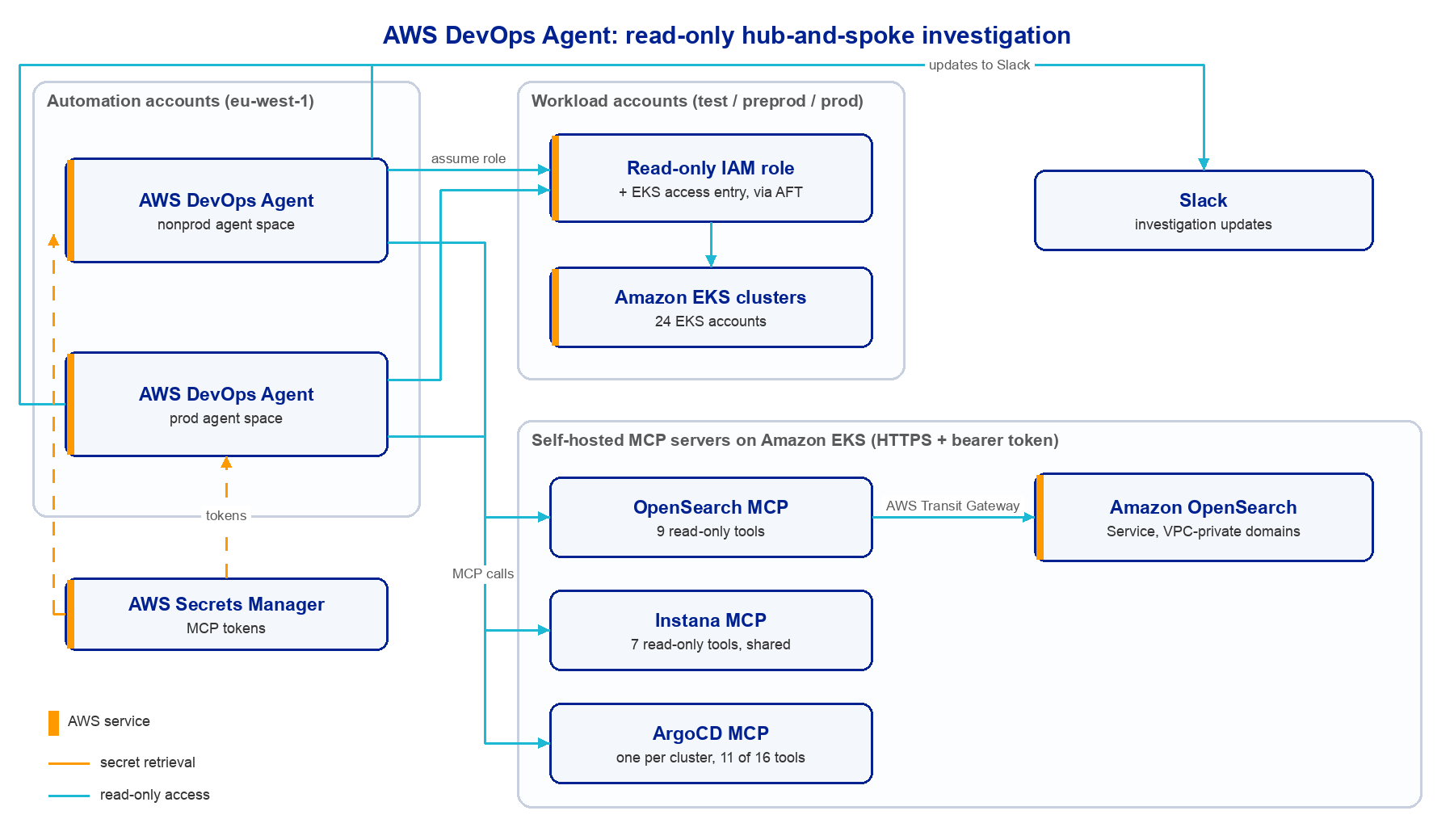
Figure 1. AWS DevOps Agent hub-and-spoke architecture.
Architecture
Each hub is an automation account holding an agent space. Every workload account carries the same read-only role, trusted only by the AWS DevOps Agent service principal from the hub's account and region, plus a read-only EKS access entry. AWS CloudTrail records every role assumption.
Non-AWS telemetry arrives through MCP servers built from upstream open-source images and run on Amazon EKS. The OpenSearch server (9 read-only tools) reaches the VPC-private domains over AWS Transit Gateway and accepts only the agent's egress IPs. The Instana server exposes 7 tools, and each ArgoCD server uses a read-only account on its own cluster. All tokens live in AWS Secrets Manager.
Service selection
|
Service |
Why chosen |
Key alternative considered |
|---|---|---|
|
AWS DevOps Agent |
Managed agentic investigation; AWS runs the model, and memories are isolated per agent space |
A custom agent on Amazon Bedrock AgentCore, kept for later workflows |
|
Self-hosted MCP servers on Amazon EKS |
One authenticated, read-only interface to each non-AWS source |
Forked connectors, rejected for pinned upstream releases |
|
AWS Control Tower Account Factory for Terraform (AFT) |
Vends the same read-only role to every workload account, with no hand-built IAM |
A per-account spoke tree in Terragrunt, kept for the hubs only |
|
AWS Secrets Manager |
Bearer tokens stay out of the repository and out of Terragrunt leaf files |
Tokens in the repository or in Terragrunt leaf files |
Key architectural decisions
- One agent space per environment. Nonprod and prod each get their own hub, with no trust between them. This serves the Security pillar: a nonprod investigation can never reach production.
- Spoke roles before hubs. The role trusts the hub's account and region, not one agent space ARN, so AFT rolled it out in June 2026, before any production agent space existed, while staying closed to confused-deputy misuse.
- One uniform role name everywhere. The hubs build role ARNs without cross-module dependencies, and a new account is one line in the inventory.
- Read-only by design. Directed actions are disabled, no elevated role exists, and the five mutating ArgoCD tools are off, leaving 11 of 16 connected. An engineer always applies the mitigation.
Alternatives rejected
|
Approach |
Why rejected |
|---|---|
|
Promote the proof-of-concept agent space |
Console-built in the root account; not reproducible or reviewable |
|
A single ArgoCD MCP server for the estate |
Trumore has no central ArgoCD; every cluster runs its own, so one server per cluster was the only read-only path |
|
Technically split the shared Instana tenant |
A group-level change outside Trumore's control; scoping is enforced in the instructions and tested by an acceptance scenario |
The hardest problem
Taking a proof of concept to production without widening the agent's access.
The proof of concept found useful evidence but could not go to production. Nothing was in code, it sat in the most privileged account, and extending it by hand to 24 EKS accounts meant a different IAM shape in each.
kloia rebuilt it instead. Both agent spaces moved into automation accounts, and each workload account's part shrank to one standard read-only role, vended ahead of time through AFT. The hardest part, reaching VPC-private OpenSearch domains from an AWS-managed agent, was solved by running the MCP server inside the network on a shared EKS cluster, routed over AWS Transit Gateway and open only to the agent's egress IPs. With the roles already in place, the prod agent space went live on 24 August, six days after Trumore approved the plan.
Delivery phases
|
Phase |
When |
Work |
Deliverables |
|---|---|---|---|
|
1. Proof of concept |
Feb 2026 |
Console-built nonprod agent space with OpenSearch MCP |
Evidence of useful signals |
|
2. Organization-wide spoke roles |
15 Jun 2026 |
Read-only role vended through AFT to 17 prod and 26 nonprod accounts |
Cross-account roles, acceptance criteria AC1 to AC7 met |
|
3. Design and approval |
29 Jul to 18 Aug 2026 |
Design and delivery plan |
Customer-approved plan |
|
4. Agent spaces live |
19 to 24 Aug 2026 |
Nonprod on 19 and 20 Aug; prod on 24 Aug |
Two agent spaces; 8 prod accounts connected |
|
5. ArgoCD across production |
By 21 Sep 2026 |
ArgoCD MCP integrated for every prod domain |
8 prod ArgoCD integrations, 364 applications |

Results
Mean time to resolve production incidents fell 78%, from 100 minutes to 22, and no production incident has run past an hour since go-live, compared with 4 of 11 before.
|
Metric |
Before (Jan to 22 Sep 2026) |
After (22 Sep to 17 Nov 2026) |
Delta |
|---|---|---|---|
|
Mean time to resolve, prod incidents with a postmortem |
100 min (n=11) |
22 min (n=6) |
-78% |
|
Median time to resolve, same incidents |
20 min |
17 min |
-15% |
|
Prod incidents over 60 minutes |
4 of 11 (median 210 min) |
0 of 6 (longest 47 min) |
No long outages |
|
Agent investigation, start to root cause and mitigation plan |
Not measured |
Median about 20 min (n=6) |
New capability |
|
Prod coverage under one agent |
Three tools correlated by hand |
8 prod accounts, 364 ArgoCD applications |
One view |
kloia recorded the baseline before go-live. On-call engineers investigated all six later incidents with AWS DevOps Agent, and agent times come from its Slack posts. The sample is small, and most of the gain comes from removing long outages. In one investigation the agent called 70 tools across 8 prod accounts and flagged four clusters still on EKS 1.31.
Success criteria
|
Success criterion |
Outcome |
|---|---|
|
One agent per environment sees every account and cluster |
Met: roles in 17 prod and 26 nonprod accounts; all 8 prod domains connected |
|
Non-AWS telemetry over authenticated HTTPS, tokens only in AWS Secrets Manager |
Met: OpenSearch, Instana and ArgoCD MCP servers behind HTTPS and bearer tokens |
|
The agent cannot make changes |
Met: read-only roles, directed actions disabled, 11 of 16 ArgoCD tools connected |
|
Trumore can run and extend it |
Enabled: PR-reviewed IaC; a new account is one inventory line |
What this unlocks
- Alarm-triggered investigations: webhooks and Instana alert relays can start an investigation from the alert itself.
- Controlled actions: a narrowly scoped, approval-gated elevated role can be added later behind a separate security review.
- Trumore-specific agents: the same authenticated MCP servers can serve custom agents built on Amazon Bedrock AgentCore.
- Scheduled operational reviews: scheduled agents can produce a weekly operations report tied to the backlog.
Lessons Learned
-
- The agent narrows the search; engineers own the conclusion. In one incident it started 20 minutes before the on-call engineer and ruled out a deployment change, but stopped at database lock contention. The root cause was a message-broker disk alarm upstream.
- Put the spoke roles in place first. Vending the read-only role through AFT months ahead meant production rollout waited on no account-level change.
- Collect accuracy ratings from the first investigation. Engineer ratings of root-cause accuracy were not built into the workflow from day one and should have been.
Trumore cut mean production incident resolution time by 78% and took AWS DevOps Agent from proof of concept to production in six days from design approval, using a read-only hub-and-spoke architecture with self-hosted MCP servers delivered as Terragrunt infrastructure as code.
kloia is an AWS Premier Tier Services Partner specializing in cloud modernization, AI-driven platform engineering, and AWS Marketplace solutions.
Case Studies
Open-Source Observability Transformation on AWS