
The Problem

Why AIDLC?

Faster delivery
Tens of dollars per feature, hours of elapsed time. Not weeks.

Built-in compliance
Every action audited. Every dollar attributed to an issue.

Institutional memory
The pipeline learns. The org's knowledge stops walking out the door.

Faster onboarding
New engineers ramp on a pipeline that already knows the codebase. 

A pipeline that improves
Each cycle's retro feeds the next cycle's configuration.

Humans stay in control
Agents propose. Humans approve. Every merge is gated.

Problems

Why AIDLC?

Observability Standard

OpenTelemetry:
Baked in, not bolted on

We instrument every migrated workload with OpenTelemetry from day one, giving you vendor-neutral traces, metrics, and logs across your entire estate.
What we wire up on every engagement

Auto-instrumentation of .NET and Java services → ADOT collector sidecars on EKS → AWS X-Ray for distributed tracing → CloudWatch for metrics and logs → custom dashboards and SLO alerting. All traces, metrics, and logs flow through a single OTel pipeline, swap backends without re-instrumenting.

VM → Container replatforming

Move off bare VMs onto EKS with proper orchestration, autoscaling, and workload isolation.

Custom metrics

Business and technical KPIs exported via OTel metrics SDK to CloudWatch and Managed Prometheus.

Structured logging

JSON-structured logs with trace correlation IDs, shipped to CloudWatch Logs Insights.

SLO alerting

Composite alarms and SLO burn-rate alerts wired from day one not as an afterthought.

Before & After

What changes in your architecture

Before
Monolithic .NET / Java app on VMs
After
Containerized microservices on EKS
Before
Self-managed relational DB on EC2
After
Amazon Aurora / RDS with redesigned schema
Before
On-prem RabbitMQ / ActiveMQ
After
Amazon SQS / MSK / EventBridge
Before
No distributed tracing or correlation
After
Full OTel traces, metrics, and logs
Before
Single AWS account, manual IAM
After
AWS Control Tower multi-account with guardrails
Before
Manual deployments, no CI/CD
After
GitOps pipelines with ArgoCD / CodePipeline
Enterprise Scale

AWS Landing Zone & multi-account governance

Security and compliance are not a phase, they are the foundation. We deploy enterprise-grade account structures that satisfy the most demanding regulatory requirements.
Outcomes

Measurable results our clients achieve

60-80%
infrastructure cost reduction vs on-prem VMs

10x
faster deployments via GitOps pipelines

99.9%+
availability through EKS self-healing & multi-AZ

<5 min
MTTR with full OTel trace-to-log correlation

Case Study - Trugo

Read-Only Agentic Incident Investigation for an EV Charging Platform with AWS DevOps Agent

30% → 69%
Median time to resolve production incidents down 69%, against an agreed target of 30%

Key AWS Services
AWS DevOps Agent, Amazon EKS, Amazon ECR, Application Load Balancer, AWS Secrets Manager, AWS IAM, AWS CloudTrail

Client: Trugo, the electric vehicle charging platform of the Togg group
Challenge: Incident evidence spread across four telemetry tools, correlated by hand
Solution: Two isolated, read-only AWS DevOps Agent spaces with native Datadog and a hardened self-hosted Instana MCP server, delivered as reviewed IaC

Situation

Most of Trugo's incident investigation time went into correlating sources by hand.

Trugo runs its charging-plane services (OCPP, CSMS, OCPI, fleet management and SAP integration) on Amazon Elastic Kubernetes Service (Amazon EKS). The data tier combines Amazon Aurora PostgreSQL, two Amazon Managed Streaming for Apache Kafka (Amazon MSK) clusters, Amazon ElastiCache for Redis and Couchbase, across separate dev, preprod and prod workload accounts under AWS Control Tower.

kloia, an AWS Premier Tier Services Partner, already operates this platform as Trugo's managed service provider. Its incident history showed the same pattern every time: telemetry was spread across Amazon CloudWatch, Datadog (application logs), IBM Instana (application performance monitoring) and Rancher Monitoring, and every investigation started from a blank screen.

Key contributing factors

  • Four telemetry tools, each holding part of an incident's evidence, with no single place to query them together.
  • IBM Instana had no native AWS DevOps Agent integration, and its upstream Model Context Protocol (MCP) server answered requests without authentication.
  • The Instana tenant was shared with other Togg group companies, so an agent could read their telemetry and report it as a Trugo finding.
  • A production-facing agent with more access than it needed was the leading security risk.

Task

Make every incident investigation start from correlated evidence, with an agent that is read-only, scoped to Trugo's own data and proven before adoption.

Constraints

  • The agent had to be read-only, evidence-based and human-approved in every environment.
  • All infrastructure had to live as reviewed infrastructure as code (IaC) in Trugo's own repository, with production changes only through approved pull requests inside known change windows.
  • Production and nonproduction had to stay isolated, and everything had to run in eu-west-1.

Definition of success

  • The adoption decision rests on evidence: inventories and a feasibility assessment approved before any build.
  • The agent sees every Trugo environment and EKS cluster, reaches Datadog and Instana securely, provably cannot make changes, and stays inside Trugo's own data.
  • At least five production and five nonproduction investigations are scored, with 80% or more of root causes marked correct, and Trugo's team runs at least one operational runbook itself.
  • Three KPIs agreed with Trugo: median time to resolve production incidents down 30%, median investigation time down 50%, and root-cause accuracy of 80% or more.

Scope

In scope:

  • Read-only inventories of the dev and prod accounts, a fit/gap matrix, MCP feasibility for Instana and ArgoCD, a monthly cost estimate and a security and data-protection design, approved in week one
  • Two agent spaces in dedicated automation accounts: one for prod, one shared by dev and preprod
  • A read-only IAM role and EKS access entry in each of the three workload accounts
  • Native Datadog integration (EU site) for both agent spaces
  • A self-hosted Instana MCP server shared by both agent spaces, behind HTTPS, an authentication sidecar and an IP allowlist
  • Slack integration, a Trugo instruction set, starter memories, acceptance scenarios, guides, runbooks and user training
  • A 70-control acceptance framework (36 Critical) across ten domains, from identity to cost visibility

Out of scope:

  • Directed actions or any write access for the agent (no elevated IAM role was defined)
  • ArgoCD MCP and a native Grafana integration for Rancher Monitoring
  • Database-level visibility into Couchbase
  • Alarm-triggered automatic investigations through webhooks or ticketing
  • Monitoring of the Aurora secondary clusters in eu-west-2, pending a decision on their disaster recovery role
  • Technical separation of the shared Instana tenant, a group-level decision
  • Changes to Trugo applications, alarm rules or existing monitoring tools

Roles and stakeholders

Role

Party

Responsibility

Senior Platform Architect

kloia

Assessment, security design, agent spaces, acceptance

Platform Engineer

kloia

Instana MCP, integrations, runbooks

Project Manager (part-time)

kloia

Timeline, weekly status notes, change requests, checkpoints

Platform Team

Client

Accountable for delivery; PR review, inventory confirmation, accuracy scoring

Information Security and Data Protection

Client

Security design approval; directed-actions and shared-tenant decisions

Observability Owner

Client

Datadog OAuth and service user, Instana read-only tokens

Action

kloia built two isolated, read-only agent spaces that reach every Trugo account and both third-party telemetry sources.
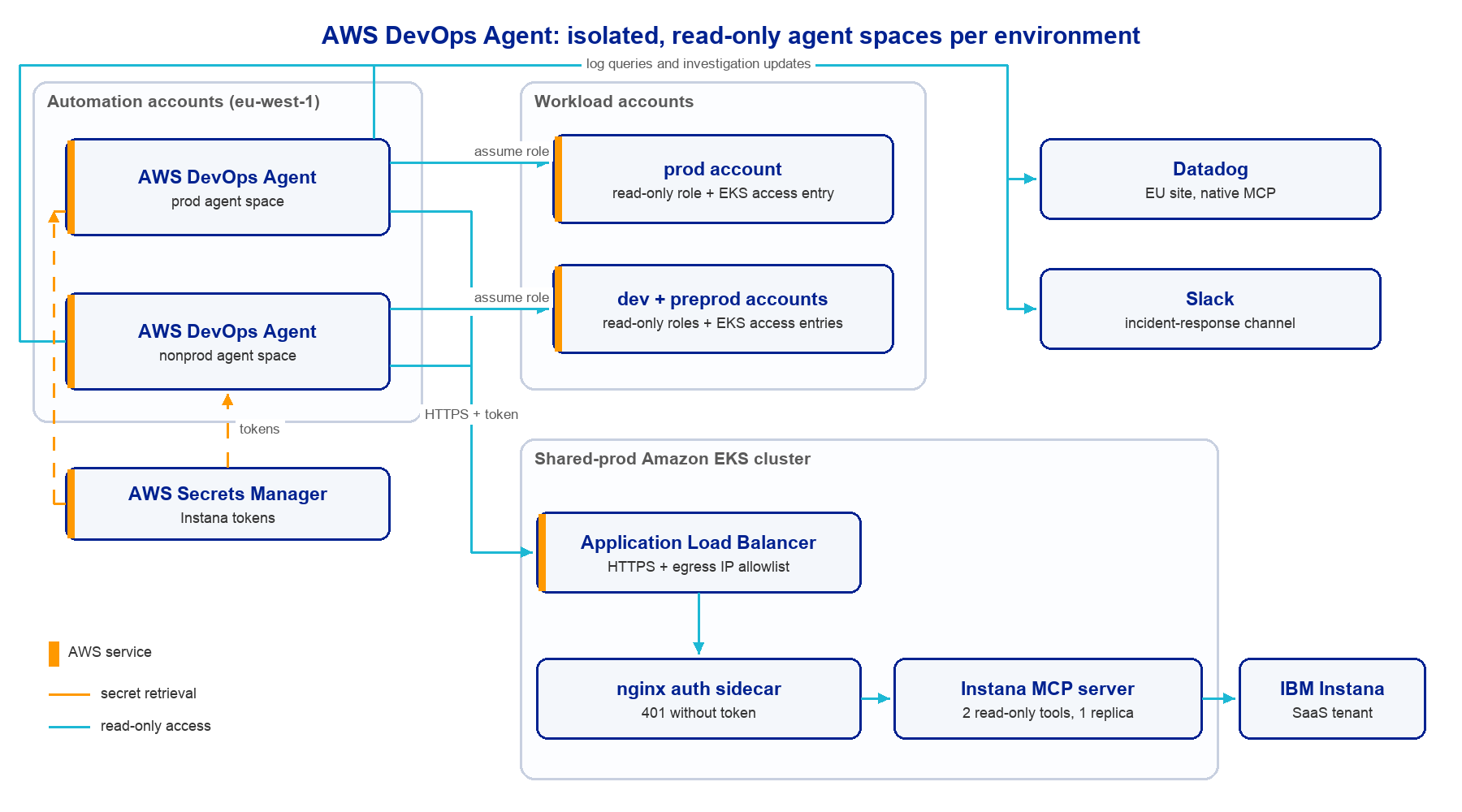
Figure 1. Isolated, read-only AWS DevOps Agent spaces for Trugo.

Architecture

Each agent space lives in its own automation account. Every workload account carries one read-only role, trusted only by the AWS DevOps Agent service and pinned to the consuming account and region, plus an EKS access entry with the AWS-managed AI Ops assistant policy and no cluster-admin rights. The prod agent space reads only prod; the nonprod agent space reads only dev and preprod. AWS CloudTrail records every role assumption.

Datadog connects natively through its EU-site MCP endpoint, with a separate registration per agent space. Instana is reached through the upstream open-source MCP server, pulled unmodified into Amazon Elastic Container Registry (Amazon ECR) and deployed on an existing shared-prod EKS cluster. An Application Load Balancer terminates HTTPS and accepts only AWS DevOps Agent egress IPs. An nginx sidecar rejects any request without a valid token, and only two read-only tools are exposed. Each agent space has its own read-only Instana token in AWS Secrets Manager. Investigation results post to Trugo's incident-response Slack channel.

Service selection

Service

Why chosen

Key alternative considered

AWS DevOps Agent

Managed agentic investigation with per-space isolation, Slack output and native Datadog support

A custom agent on Amazon Bedrock AgentCore, kept for later Trugo-specific workflows

Amazon EKS (shared-prod cluster) for the Instana MCP server

Load balancer controller, wildcard certificate and DNS zone already in place; the server needs only outbound HTTPS

AWS Fargate on Amazon ECS, which needed a new certificate and DNS setup

AWS Secrets Manager

Instana tokens are read at apply time and never stored in the repository

Tokens in IaC variables or files

AWS IAM with EKS access entries

Read-only access to accounts and clusters without editing cluster auth config

Cluster-admin or broader IAM grants, rejected under the read-only principle


Key architectural decisions

  • One agent space per environment tier. The prod agent cannot read nonprod and the nonprod agent cannot read prod; both are built from the same modules with a role-name override. This serves the Security pillar.
  • Trust and consumer reviewed together. Each workload role's trust policy and the agent space that uses it deploy from the same repository, so a reviewer sees both sides of the trust in one pull request.
  • Read-only by design. Directed actions are off, no elevated role exists, and engineers apply every mitigation under a "verify the evidence, then act" rule.
  • Shared-tenant risk handled in instructions and recorded. The instruction set limits Instana findings to Trugo's own clusters and namespaces and requires cluster attribution on every finding. An acceptance scenario confirms that other group companies' telemetry is not reported as Trugo's, and the residual risk carries a KVKK and GDPR sign-off.
  • Prod first. A read-only design carries no write risk, and incident value is highest in production, so the prod agent space came first and nonprod followed with the same modules.

Alternatives rejected

Approach

Why rejected

Host the Instana MCP server on the observability cluster

The cluster was no longer maintained

Host it on Trugo's production cluster

Puts an integration component inside the blast radius of customer workloads

Technically split the shared Instana tenant

A Togg group-level change outside the engagement; scoping is enforced in instructions and tested


The hardest problem

Exposing an unauthenticated, stateful MCP server to a managed agent without widening the attack surface.

The upstream Instana MCP server was the only read-only path to Trugo's application performance data. It answered requests without checking for a token, and its full tool set went well beyond what an investigation needs.

The usual way to run such a server, several replicas behind a load balancer, failed. The server keeps MCP session state in memory per pod, so requests landing on a different replica returned "Session not found". kloia's working design runs a single replica with liveness and readiness probes, documented as a deliberate choice.

Security comes in layers instead of code changes. An nginx sidecar returns 401 to any request without the token header. The container port is reachable only inside the pod. The load balancer accepts only AWS DevOps Agent egress IPs for eu-west-1. The registration allowlists just two read-only tools (infrastructure analysis and event lookup). The upstream image is never forked; a bug is handled by pinning the last known good release and reporting it upstream.

Delivery phases

Week

Work

Deliverables

1

Kickoff, read-only inventories, fit/gap, cost estimate, security design

Approved feasibility assessment, security design note and ADR

2

IaC, prod role and EKS access, prod agent space, Datadog, Instana MCP, Slack

Pull requests with plan output

3

Prod acceptance scenarios, instruction set, nonprod roles and agent space

Prod agent space and acceptance record

4

Nonprod acceptance, guides and runbooks, training, handover

Nonprod agent space, acceptance report, training


The prod agent space went live on 13 July 2026. Two weeks of hypercare followed acceptance; ongoing operation continues under kloia's existing managed service agreement.

Results

Median time to resolve production incidents fell from 121.7 hours to 38.1 hours, 69% below the pre-go-live baseline and more than twice the agreed 30% reduction.

KPI

Target

Before go-live (Jan to 13 Jul 2026)

After go-live (14 Jul to 25 Nov 2026)

Delta

Median time to resolve, prod incidents

-30%

121.7 h (n=9)

38.1 h (n=4)

-69%

Median investigation time to confirmed root cause

-50%

19 days (n=5)

Measurement in progress

Pending

Root causes confirmed correct by engineers

80% or more

69% first-time-right without the agent (9 of 13)

Measurement in progress

Pending


Both periods are measured the same way: incident tickets from creation to resolution, genuine production incidents only. The proxy includes time a ticket stayed open after service was restored, and two tickets are excluded (one opened after the incident had ended, one with no resolution date). The post-go-live sample is small, and the KPI measures the platform's outcome, not the agent's share of it. Investigation time will come from the agent's own investigation timeline and accuracy from the feedback engineers give on every completed investigation. The 69% human first-time-right rate is a comparison point, not a like-for-like baseline.

What this unlocks

  • ArgoCD visibility: GitOps sync history and application health can be added with the same self-hosted MCP pattern used for Instana.
  • Alarm-triggered investigations: CloudWatch alarms, Instana alerts or service-desk incidents can start an investigation through an agent space webhook.
  • Trugo-specific agents: the same authenticated MCP servers can serve custom agents built on Amazon Bedrock AgentCore and Strands Agents.
  • Proactive reliability reviews: evaluations and scheduled reports can run on the same read-only access.

Lessons Learned

  • Treat MCP server state as an architectural constraint. In-memory session state rules out horizontal scaling, so availability has to come from probes and fast restarts, and the single replica must be written down so no one "fixes" it later.
  • Record what you cannot separate. A shared telemetry tenant cannot always be split; scoping instructions, a scenario that tests them and a recorded data-protection decision make the residual risk visible and owned.
  • Move IaC without touching live resources. The agent space IaC started in a standalone repository and moved into Trugo's main repository with the live agent space identity pinned, so the production agent space was adopted without being destroyed and recreated.

Since taking a read-only AWS DevOps Agent live in July 2026, with native Datadog and a hardened self-hosted Instana MCP server delivered as reviewed infrastructure as code, Trugo has resolved production incidents 69% faster at the median than before go-live, more than twice its agreed target.

kloia is an AWS Premier Tier Services Partner specializing in cloud modernization, AI-driven platform engineering, and AWS Marketplace solutions.

Case Studies

test-image

Open-Source Observability Transformation on AWS

test-image

Open-Source Observability Transformation on AWS

test-image

Open-Source Observability Transformation on AWS

Let's Work Together