

The Problem
No company context
AI tools write code without knowing your codebase, your specs, your stored procedures, your standards. Generic in, generic out.
Zero audit trail
Nobody knows what changed, by whom, against which spec, at what cost. When something breaks, the log is empty.
Knowledge stays siloed
The senior engineer's head is still the source of truth. The pipeline learns nothing. That person leaves, the knowledge walks out.
Pilot never becomes default
The shiny demo works. Then adoption stalls. The new way of working never replaces the old one.
Why AIDLC?
Faster delivery
Tens of dollars per feature, hours of elapsed time. Not weeks.
Built-in compliance
Every action audited. Every dollar attributed to an issue.
Institutional memory
The pipeline learns. The org's knowledge stops walking out the door.
Faster onboarding
New engineers ramp on a pipeline that already knows the codebase.
A pipeline that improves
Each cycle's retro feeds the next cycle's configuration.
Humans stay in control
Agents propose. Humans approve. Every merge is gated.
Problems
No company context
Zero audit trail
Knowledge stays siloed
Pilot never becomes default
Why AIDLC?
Faster delivery
Built-in compliance
Institutional memory
Faster onboarding
A pipeline that improves
Humans stay in control
OpenTelemetry:
Baked in, not bolted on
Auto-instrumentation of .NET and Java services → ADOT collector sidecars on EKS → AWS X-Ray for distributed tracing → CloudWatch for metrics and logs → custom dashboards and SLO alerting. All traces, metrics, and logs flow through a single OTel pipeline, swap backends without re-instrumenting.
VM → Container replatforming
Move off bare VMs onto EKS with proper orchestration, autoscaling, and workload isolation.
Custom metrics
Business and technical KPIs exported via OTel metrics SDK to CloudWatch and Managed Prometheus.
Structured logging
JSON-structured logs with trace correlation IDs, shipped to CloudWatch Logs Insights.
SLO alerting
Composite alarms and SLO burn-rate alerts wired from day one not as an afterthought.
What changes in your architecture
AWS Landing Zone & multi-account governance
AWS Control Tower
Security baseline
Identity & access
Network architecture
FinOps & cost governance
Compliance as code
Measurable results our clients achieve
60-80%
infrastructure cost reduction vs on-prem VMs
10x
faster deployments via GitOps pipelines
99.9%+
availability through EKS self-healing & multi-AZ
<5 min
MTTR with full OTel trace-to-log correlation
Case Study - Airline Customer
Continuous Passenger Journey Validation for a Major Airline
3x
Daily Validation Windows
4
Critical Journey Validation Stages
Client: Confidential Airline Customer
Status: For Review
Project type: Datadog Browser Synthetic Monitoring and Digital Journey Assurance
Application: Customer-facing airline web application
Situation
A major airline operates customer-facing digital booking and check-in journeys through its web application. Service availability alone does not guarantee that a passenger can successfully complete the full process.
A technically healthy component can still fail later in the browser journey, for example during booking confirmation, check-in or boarding pass generation. The operational need was therefore to validate the complete passenger experience instead of monitoring isolated pages or endpoints.
Task
Build an automated monitoring approach that behaves like a real passenger and verifies critical booking and check-in flows throughout the day.
The work carried hard constraints:
-
Run recurring booking and check-in scenarios across multiple daily execution windows.
-
Complete a booking for a future flight and carry the generated booking context into check-in.
-
Validate successful check-in and confirm boarding pass generation.
-
Preserve step-level execution evidence for troubleshooting.Integrate operational reporting and booking-cancellation follow-up.
-
Protect sensitive payment data throughout synthetic execution and evidence capture.
Action
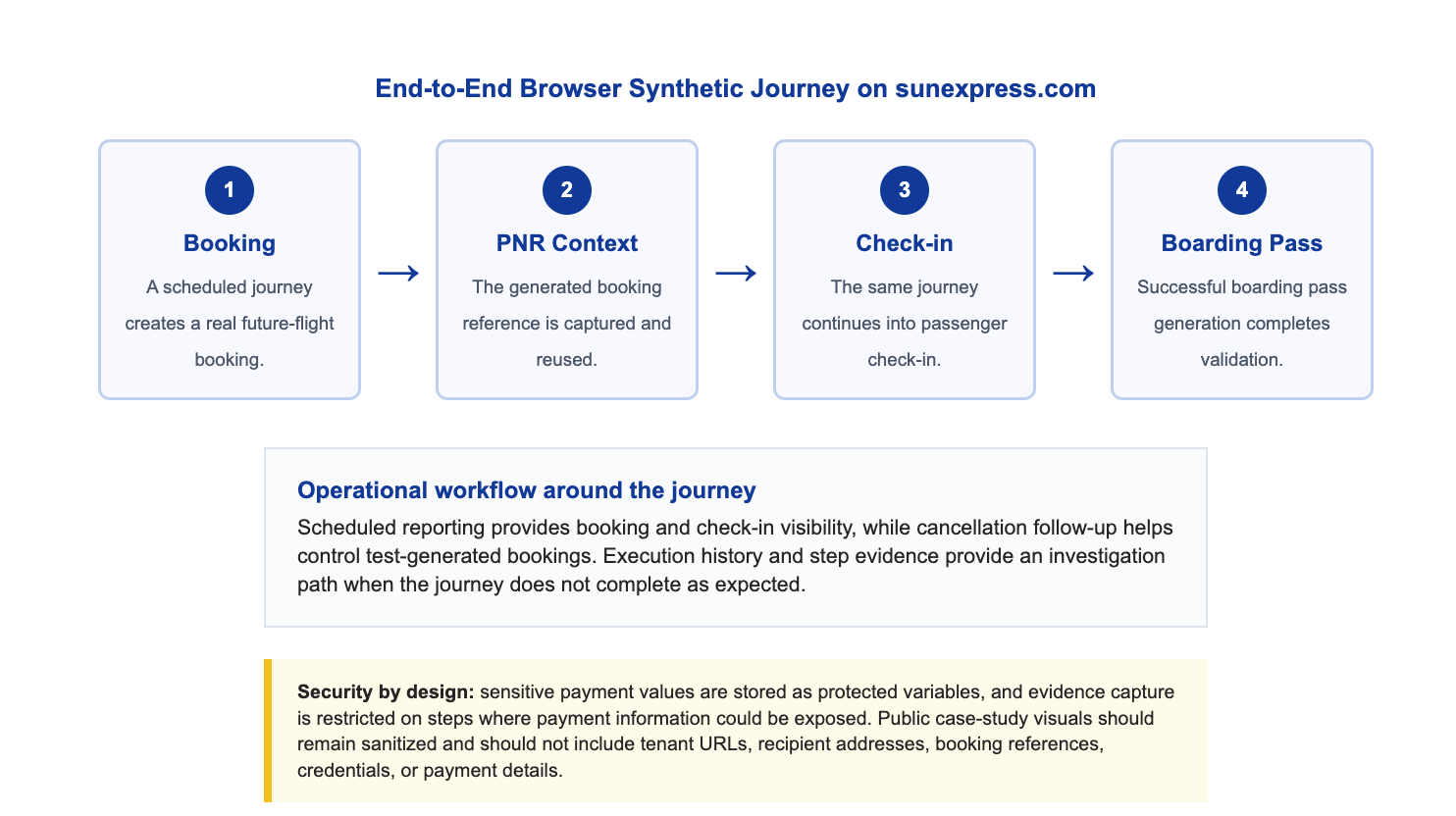
The Kloia QA team, supported by the Observability team, worked with the customer to implement scheduled browser synthetic journeys that validate the complete booking and check-in lifecycle as a single end-to-end web flow.
How it was built:
-
Morning, afternoon, and evening synthetic journeys provide recurring validation during the operating day.
-
Each journey books a selected future flight, captures the booking reference, continues into check-in, and verifies successful completion.
-
Boarding pass generation is used as a final business-level validation point.
-
Step-level screenshots and execution history support investigation when a journey fails.
-
Scheduled reports summarize booking and check-in results and help identify bookings that require cancellation follow-up.
-
Payment-related test variables are hidden and obfuscated, and screenshots are avoided on steps where sensitive card data may appear.
Results
The solution moved monitoring beyond page availability to end-to-end browser journey validation. Browser synthetic tests continuously exercise the airline's digital booking and check-in experience, providing a direct business-level signal that the passenger journey is functioning as expected.
-
End-to-end booking and check-in flows are validated as connected business journeys.
-
Multiple execution windows provide recurring assurance throughout the day.
-
Business-impacting failures can be detected at the exact step where the journey breaks.
-
Step-level evidence gives operational and QA teams a faster starting point for troubleshooting.
-
Scheduled reporting and cancellation follow-up extend monitoring beyond a single test run.
-
Post-test cancellation, refund initiation, and next-day status reporting extend validation beyond the passenger journey to include test-data cleanup and follow-up on outstanding bookings.
-
Sensitive payment information is explicitly protected within the test design.
The airline now has an automated way to continuously answer a business-critical question: can a passenger successfully book, check in, and receive a boarding pass?
Case Studies

Open-Source Observability Transformation on AWS
Open-Source Observability Transformation on AWS